Sabres and Snakes In 1949, the Royal Australian Air Force (RAAF) began assessing replacements for its locally-built Commonwealth Aircraft Corporation (CAC) Mustangs and De Havilland Australia (DHA) Vampires. A combination of US and British designs were considered. CAC also submitted a detailed proposal for a twin-jet, all-weather fighter with a two-seat cockpit, the CA-23. This proposal garnered strong interest and accordingly the Department of Defence Production granted funds to CAC for further development of its concept.
The CAC CA-23 concept looked very impressive on paper. A twin jet delta winged design, it promised a Mach 1.5 top speed as well as all weather capability thanks to a second crew member and integral radar. Alas, it may have been a step too far. The design started to fail key design criteria and costs started to climb. Fearing a risk that the project would be cancelled in 1950, Sir Lawrence J Wackett, the Head of CAC, started to look for alternative fall-back options. Given CAC’s long history with North American this was an obvious starting place.
Initial interest was upon a licensed produced variant of the North American F-86 and indeed Wackett had his design team do a quick analysis of this including a potential variant re-engined with a more powerful Rolls-Royce Avon engine. This engine was already entering production at CAC to power the English Electric Canberra B.20 bombers that Australia had selected. While at North American’s offices in Los Angeles though Wacket became aware of a more advanced design in development. This was named the Sabre 45 in reference to its 45° wing sweep and represented a significant evolution of the company's F-86 Sabre. Of most interest, it promised a supersonic capability and with the power of North American behind it and interest from the USAF, it potentially offered a safe fallback.
A licence agreement to produce the new type was negotiated. This was a fortuitous move as by the end of the next year the CA-23 program was cancelled. Moving to quickly fill the gap left, Wackett proposed the “off-the-shelf” design – now called the YF-100A. This was pitched as a low-risk solution, leaning heavily on North American and USAF investments and similar. Not wanting to be caught without a new fighter and with existing types such as the Meteor and Vampire already rapidly being outclassed, the RAAF and Government quickly agreed to the new proposal. That said, as an interim bridging capability, the RAAF leased 48 F-86Es from the USAF.
As CAC looked further into the design of the YF-100, one concern that was identified was the new Pratt & Whitney J57. Not that there was anything wrong with the engine per se but rather that it would represent yet another engine type to possibly introduce. Noting that the RR Avon was already in production and offered good performance, it was suggested that this type should be considered for the new Australian development. CAC took this on and quickly came up with a novel solution involving not just the Avon but indeed, two of them. Fitted side-by-side, twin reheated RA-19Rs were proposed. As a side effect, this also satisfied those who had believed the similar arrangement for the CA-23 was superior, offering a redundancy option.
The new CAC CA-26 Super Sabre prototype would have its first flight on 3 August 1954. A production order for an initial 22 of the production CA-27 Super Sabre Mk 30 was soon agreed. In addition to the twin Avons, the type also changed the armament from four 20mm M39A1 cannon to a pair of the harder hitting 30 mm ADEN cannons. Performance wise the new type actually exceeded the J57 powered F-100 with increased thrust coupled with the smaller size/lower weight of the Avon delivering increased speed, service ceiling and rate of climb:
| | J57 Powered F-100A | | RA-19R Powered CA-27 |
| Max Power (Augmented) | | 15,000 lb | | 17,500 lb |
| Military Power | | 9,220 lb | | 11,400 lb |
| Max Speed @ 35,000ft | | 751 Kn (Mach 1.31) | | 827 Kn (Mach 1.44) |
| Max Rate of Climb | | 18,800 FPM | | 39,600 FPM |
| Service Ceiling | | 55,600 ft | | 58,050 ft |
Over the next six years the Sabres progressively equipped No. 75 Squadron RAAF (75 Sqn), No. 3 Squadron RAAF (3 Sqn), No. 77 Squadron RAAF (77 Sqn) and No. 76 Squadron RAAF (76Sqn). As they did the leased F-86Es were returned to the USA.
An improved second batch (designated CA-27 Super Sabre Mk 31) was ordered. This incorporated some further modifications such as Additional fuel tanks in the wings, fighter-bomber capability, and probe-and-drogue refuelling capability (satisfied by the purchase of 4 dH Comet airliners converted to act as aerial refuelling aircraft). The earlier Mk 30 aircraft were also bought up to this standard. Eventually 112 of the type would enter RAAF service. A further modification was made in 1960 when the ability to use air-to-air missiles was added. This would be satisfied by the AIM-9B Sidewinder with four of the type being able to be carried. When given this capability the designation was changed to Mk 32.
The type was loved by its pilots as it offered superlative performance. From 1958 to 1960, CAC Super Sabres of No. 78 Wing RAAF, comprising 3 Sqn and 77 Sqn, undertook several ground attack sorties during the Malayan Emergency. Following this they remained in Malaysia and were responsible for regional air defence during the Konfrontasi between Indonesia and Malaysia from 1963 until 1966. In 1962, No. 79 Squadron RAAF was sent from RMAF Butterworth to Ubon Royal Thai Air Force Base (RAAF Ubon), Thailand, to assist the Thai and Laotian governments in actions against communist insurgents. While here they also provided local air defence to USAF attack and bomber aircraft based at the same location.
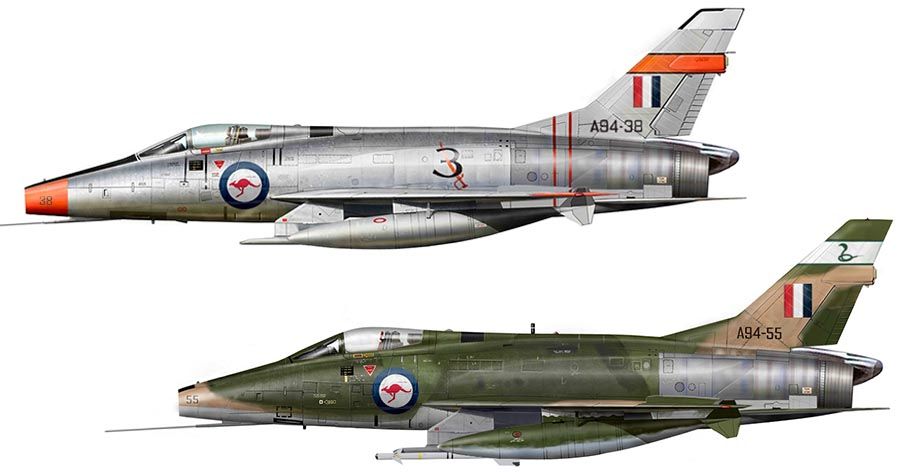
Bottom: A CAC CA-27 Super Sabre of No. 79 Squadron at RAAF Ubon, Thailand in early 1968. The SEA camouflage scheme has been locally-applied courtesy of the USAF's 8th Field Maintenance Squadron (part of the 8th TFW). These fighters flew as the RAAF component of USPACCOM's Mainland South East Asia Air Defence Network. Note the twin Sidewinder missiles on the inboard pylons.
Technically, due to their upgrades, both of the Super Sabres above are Mk.32s. However, the 3 Sqn aircraft originated as part of the initial batch of Mk.30s (A94-23 to A94-39) while the 79 Sqn fighter came from the second batch of Mk 31s (A94-40 to A94-67). ----------
Following the Super Sabre production CAC was looking for a replacement military project. Fortuitously something was on the table. As early as 1954, Australia had recognised that the EE Canberra bomber was becoming outdated. The Canberra was incapable of providing adequate coverage of Indonesia from Australian bases, and was evaluated as having a "very low" chance of survival if it encountered modern fighters. A study recommended one of the British V bombers, but this was rejected on the basis of cost and fear that any type would also be outdated. While the Government vacillated on the matter the calls for something became louder both from the RAAF and due to Indonesia's increasingly aggressive statements regarding Malaysia.
Into this Wackett once again stepped to offer a solution. Again, a North American derived solution was put forward. This would be the new North American A3J Vigilante. Developed as a carrier-based strike aircraft this type offered a massive leap over the Canberra with a top speed of Mach 2 and range of 1800 km. It was also very rugged due to its need to operate from carriers. The one feature that was questioned was its weapon load. This was quite unique being based upon the unusual "linear bomb bay" between the engines in the rear fuselage, which allowed the single nuclear weapon, commonly the Mk 28 bomb to be dropped at supersonic speeds. Although the RAAF did have desires to adopt nuclear weapons, at this stage they also wanted a conventional capability, and one not so focussed as that on the Vigilante. CAC offered that this was easily accommodated and that they would develop a more conventionally armed variant. This replaced the droppable “stores train” as it was known with permanently fitted fuel tanks, thus conferring increased range. Weapons would instead be loaded on under wing and under fuselage pylons. This offer was soon adopted with a production order for the new type made in 1962. Not only did the type offer a production solution for CAC’s aircraft division, the GE J79 engine was also put in production by the engine division.
The resulting CAC CA-29 Mk.10 was largely identical to the USN’s newly designated North American A-5B with the exception of the previously described weapons/fuel changes. A total of 48 of the type were ordered by the RAAF. These were also followed by a further 12 MK.20s which was a dedicated reconnaissance type based upon the RA-5C. In service The CA-29s would serve with No.s 1, 2, 4 and 6 Squadrons RAAF along with No. 1 Operational Conversion Unit RAAF. They were also used regularly by the RAAF Aircraft Research and Development Unit (ARDU). In RAAF service they also received their nickname of “Snake” believed to have derived from the comment that they were “as slick as a snake”.
In 1967, the RAAF deployed 8 CA-29 Mk.10 and 3 Mk.20 Snakes and to the Vietnam War. Operating under the control of No. 2 Squadron, even though technically the Mk.20 reconnaissance versions were from No. 4 Squadron, the aircraft were typically operated in the low-level bombing role, taking responsibility for South Vietnam's southernmost military regions. Upon their redeployment from Vietnam in 1971, No. 2 Squadron had flown about 12,000 sorties and dropped 76,389 bombs, and lost two of their aircraft to missiles and ground fire during the course of the war.
Upon return to Australia, all the CA-29s underwent a major upgrade of their avionics and systems. This included being given new more powerful versions of the J79 as well as the ability to carry the AN/AVQ-10 Pave Knife targeting pod – this was actually faired into the belly of the bomber versions. Post the update the jets were redesignated as Mk.11 and Mk.21 respectively. With the new pods the jets were also able to carry and designate for the new Laser Guided Bombs (LGBs).
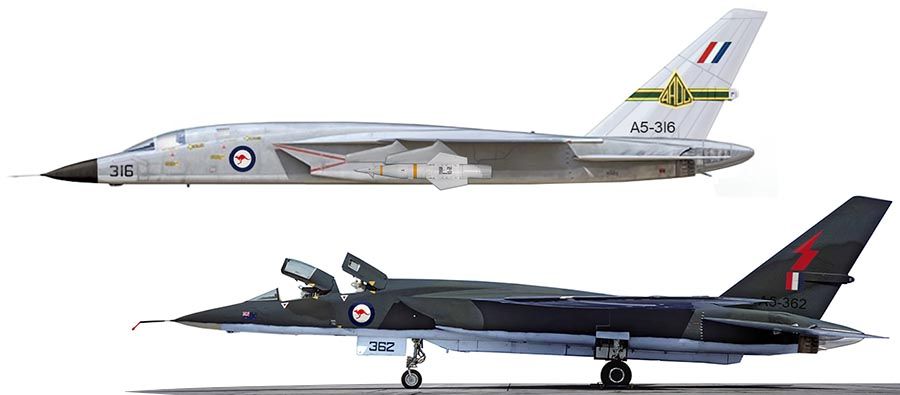
This ARDU aircraft is being used to integrate AGM-12C Bullpup B ASMs with the CA-29. Note that the ARDU crest and band have displaced the fin flash. A slanting replacement fin flash has been applied on the upper fin above the fold line.
Bottom: A5-362, a CAC CA-29 Mk.20 recce bird in the tactical markings of RAAF No.2 Squadron while based at Phan Rang AB under the USAF's 35th Tactical Fighter Wing. Although assigned to 2 Sqn, the air crew and A5-362 itself actually came from RAAF No.4 Squadron.
The dark SEA scheme was applied specifically for the deployment to Phan Rang. The red lightning bolt of 2 Sqn is worn on the all-moving tail above the fin flash. Note that the 'last three' are shown on the nose gear door (displaced by a small Australian flag on the nose). ----------
The ability to use the new J79 engines was tied to the production of the RAAF’s new fighter type. This was the McDonnell Douglas F-4E Phantom II. After 15 years of CA-27 Super Sabre service, the RAAF had selected this type as its new fighter with 116 of the type now ordered and in production as a joint effort by CAC and the Government Aircraft Factory (GAF).



