Swedish Storm Birds In the late 1960s, the Royal Air Force (RAF) was looking to acquire a new multi-role combat aircraft. Following the turmoil of the cancellation of the British Aircraft Corporation (BAC) TSR.2, the British had joined forces to jointly develop a number of combat platforms. One of these, a requirement for an advanced trainer/light attack aircraft would eventually result in the SEPECAT Jaguar. The other was less successful. This was the BAC/Dassault AFVG (Anglo-French Variable Geometry) and was two seat, twin-engined fighter using, as its name implied, a variable geometry wing. The RAF initially intended this to fulfil the fighter/interceptor role as a replacement for the English Electric (EE) Lightning. However, the specification would be repeatedly re-drafted and gradually it became more multi-role, adopting increasing strike/ground attack roles.
More importantly, the French side of the team, namely Dassault were less than reliable. Marcel Dassault was less than impressed taking a subordinate position to BAC on the program. After less than a year, Dassault began to actively undermine the AFVG project, working on two competing "in-house" projects: the variable geometry Mirage G and the Mirage F1. Finally, in June 1967, the French government announced their withdrawal from the AFVG project ostensibly on the grounds of cost. This effectively killed of the project although BAC continued to try to keep it alive looking at various redesigns. Funding for the newly designated UKVG in the United Kingdom was seriously restricted though and, the British government sought to find partners.
This effort would find a surprising entry. Although initial focus was on NATO partners, especially those in Europe, the British weren’t totally against others joining as well. One such was Sweden which had its own requirements for new fighter for the Svenska Flygvapnet. This was ostensibly being satisfied by the Saab 37 Viggen then in development. However, just like the British, the Swedes were also looking at options to share/reduce costs. After initial discussions at both government-to-government and industry levels, in July 1968, a memorandum of understanding was signed between Britain and Sweden to work together.
Because the RAF was already desperate and because the Swedes already had a prototype of their new fighter flying, the program was totally redefined. No longer would a clean sheet VG design be pursued but rather a variation of the existing Saab 37 Viggen design would be used. The fact that the Viggen also had many desirable performance characteristics including for example its short field capabilities, which removed the principle advantage of the VG wing, was not lost on the British.
This new version would be jointly produced by Saab and BAC and incorporated a number of modifications, the most important of which was a new engine, the Rolls-Royce (RR) Severn. This was a derivative of the RR Pegasus engine being used in the Hawker Siddeley Harrier also in development, thus saving development costs and offering an option of commonality. Offering a significant 35% increase in dry thrust and nearly 10% in afterburning over the existing Volvo RM8, the new engine was coupled with new variable geometry intakes somewhat similar in appearance to those on the McDonnell F-4 Phantom II. These changes would result in an aircraft able to achieve Mach 2.32. That said, the increased performance did come with a penalty in that range on internal fuel was slightly reduced resulting in the aircraft nearly always flying with a drop tank on the centre line. The new aircraft were initially named Saab-BAC Thunderbolts FGR.1 and started replacing older EE Lightnings in service. The Svenska Flygvapnet also adopted the same type as the Saab-BAC AJS-37 Viggen. Production lines were established in both Sweden and the UK.
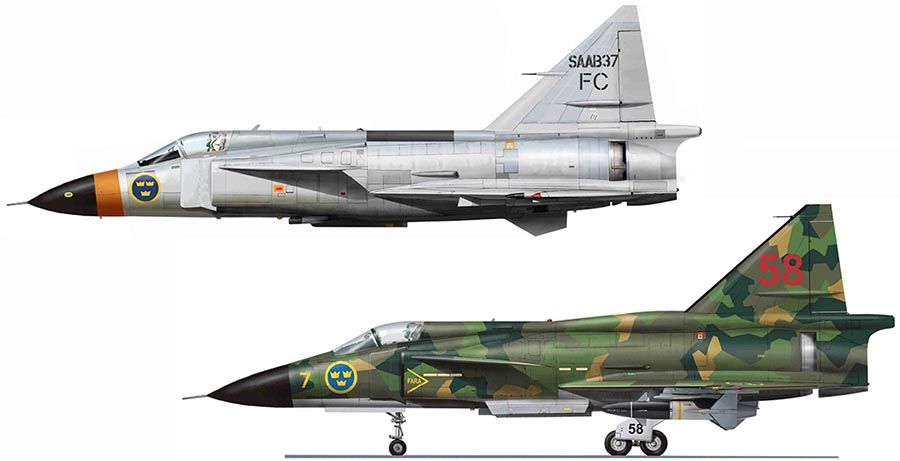
Like most early Flygvapnet fpl 37 Viggens, this aircraft was left in a natural metal finish. The fourth prototype retained its predecessors' shorter radome, canards without anhedral, straight fuselage spine, and slightly smaller tail fin. Saab fpl 37-4 differed from the earlier prototypes in having revised intakes for the new RM 11 engine - an RB.193 Severn turboshaft supplied by Rolls-Royce. [2]
Bottom: A Saab AJ 37 Viggen of the Flygvapnet's 71. attackflygdivisionen based at Såtenäs (F 7 Skaraborgs) in 1976. [3] Resplendent in FOA splitterkamouflage, this aircraft carries a pair of underwing RB o4E missiles. For anti-shipping missions, RB 04-carrying Viggens were flown in formations of four - one with a second RB 04E, one with an electronics jammer on one pylon, and two with EW countermeasures pods.
________________________________________
[1] Note, although both the Saab plant and the Försökscentralen are Linköping-based, Saab flight operations are from LPI while FC flies from Malmens flygplats.
[2] This replaced the RM 8 (P&W JT8D fitted with a Swedish-designed reheat) in the first three fpl 37 prototypes. Production fpl 37 Viggens would be powered by RM 11A engines built under license by Volvo Flygmotor at Trollhättan.
[3] Part of Flygvapnet's 1. divisionen, 71. attackflygdivisionen 'Gustav Röd' was assigned a range of attack roles but the emphasis was on anti-shipping._________________________________________
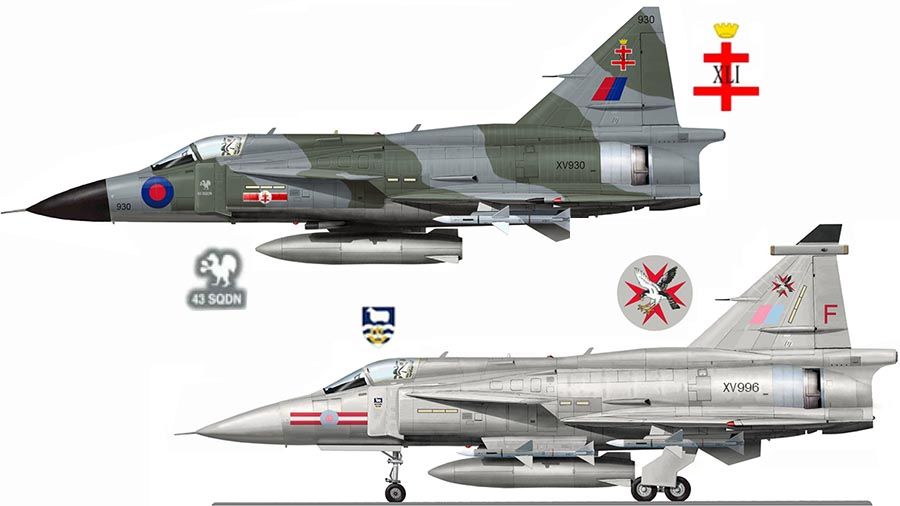
No. 41 Squadron operated the Thunderbolt in the tactical fighter reconnaissance and ground attack roles. Normally No.41 aircraft would be carrying recce pods (the RAF version of the Spaningskapsel 37) on their fuselage-side pylons.In early 1976, 'Suppression of Enemy Air Defences' (aka 'anti-radiation') missions were added to No. 41's roles.
This Thunderbolt was engaged in live fire practice at the Tain Air Weapons Range. [4] For that exercise, the FGR.1 has a bare minimum load-out. Those fuselage-side pylons have been removed and not even the central drop tank is mounted. Instead, this Thunderbolt is only carrying a pair of 'SEAD Sparrow' missiles.
For their Scottish 'radar plinking' exercise, No.41 aircraft were billeted to RAF Leuchars. While there, Thunderbolt VX930 was 'zapped' by rival No. 43 Squadron, temporarily acquiring a 'Fighting Cock' on its intake ramp. 'Proper' No. 41 Sqn markings adorn the tail fin and a banner beneath the forward electroluminescent formation lights.
Bottom: A Saab-BAe Thunderbolt FGR.1B - one of a select batch of 'Tranche 3' airframes updated to FGR.3 standards but also fitted with braking chutes, RATO attachment points, and additional survival gear to better suit these aircraft to service in the Falklands. [5] Armament is 4 x Thunderflash medium-range AAMs.
This Thunderbolt FGR.1B is shown in 1986 wearing the markings of 1435 Flight based at RAF Mount Pleasant on East Falkland. [6] Like all FGR.1Bs, pale 'lo-viz' national markings are applied to the all-over Barley Grey scheme. However, that makes some of No. 1435's more colourful markings a bit incongruous.
The 1435 Flight red-white-red banner is based on the colours of the unit's badge (inset and above the fin flash on the tail). That badge features a cross honouring No. 1435's defence of Malta during WW2. On the intake ramp (and inset) is the more contemporary Falkland Islands coat of arms. Beneath that CoA had been the marked '¿Creías que sería fácil?' (since removed because officialdom deemed that slogan to be overly provocative).
_________________________________
[4] The 'SEAD Sparrow' was an obsolete AIM-7E medium AAM modified for the Suppression of Enemy Air Defences role. The 'SEAD Sparrow' conversion required only the replacing of the American missile's original Raytheon SARH seeker with a Marconi XJ.412 passive RF seeker designed to home on radar emissions.
As a fully operational load-out, the 'SEAD Sparrow' pair would be augmented by AIM-9Ls on the Thunderbolt's outer pylons. On the fuselage pylons would be carried a chaff/IR flare pod (to starboard) and an EW jamming pod (to port).
[5] Canadair-made braking chute housings were transferred to the RAF as kits. These parachutes (and RATO fittings) were considered necessary should 1435 Flight ever need to divert to the shorter Port Stanley airstrip.
[6] RAF Mount Pleasant opened in 1985. Alongside 1435 Flight's Thunderbolt FGR.1Bs were based the Hercules C.1K IFR transport aircraft of 1312 Flight. After 1988, 1435 Flight became permanently based in the Falkland Islands.___________________________
While the immediate RAF need was to be satisfied with the Thunderbolt, there was still felt to be a need for something longer ranged. The RAF especially still pined for its lost TSR.2 and to a lesser extent cancelled F-111K. Similarly, the cancelled OR F.155 specification, for an interceptor aircraft to defend the UK from Soviet high-flying nuclear-armed supersonic bombers, from a decade or so earlier was still felt by many to be relevant and if anything, more important than ever.
On the other side of the world, the Royal Australian Air Force (RAAF) was also struggling. Despite having placed an order for F-111s as an EE Canberra replacement in 1963, the program was in trouble. Program costs, during 1963–1967, had grown at an alarming rate and by April 1967 had risen 90%. This rising price, three unexplained losses of USAF F-111As in Vietnam during their first month of deployment, and the British and U.S. Navy's orders' cancellations caused further controversy in Australia during 1968. Concurrent to this, the RAAF was starting to consider a replacement for the Dassault Mirage IIIs.
Similarly, in Canada, there was also consideration for new fighters. The CF-104 starfighters were in service and performing well but a replacement was wanted. Initially it was proposed that a derivative of the Northrop F-5A be procured but the Royal Canadian Air Force (RCAF) was far from impressed with this and indeed was doing everything possible to cancel or delay this. The ascension of Pierre Trudeau as Prime Minister in early 1968 would present an opportunity to satisfy the effort to at least cancel the F-5 option. While ideally, the newly formed combined Canadian Armed Forces (replacing the RCAF) would have liked to have purchased the McDonnell F-4 Phantom II but knew this would be politically impossible, thus they were willing to look at other options. Moreover, just as the RAF had lost their TSR.2, the RCAF/CAF had lost their equivalent in the form of the Avro Canada CF-105 Arrow a decade earlier and while an interim buy of McDonnell F-101 Voodoos had been made, it was still felt to not be a satisfactory solution.
These diverse needs would soon find a common solution.
In October 1969, following discussions commenced at the Farnborough Air Show, the partnership between Saab and BAC would be expanded to include Commonwealth Aircraft Corporation (CAC) and Canadair. The new partnership was known by the designation SBCC. It would be responsible for both production of the Viggen/Thuderbolt (first priority) and a new, longer ranged derivative.
This new derivative would initially be focussed on the long-range strike role but consideration was also given to develop a fighter/interceptor version, with both the British and Canadians taking an especial interest in this version. Saab quickly dusted off plans for a version of the Viggen they had initially pitched to the RAF/UK Government when looking to join the UKVG program. This was known as the Saab 37XE-3 and was a significantly developed version. For one, it was designed around twin engines and it was approximately 25% longer. The engines selected were the same RR Severns as used in the Viggen/Thunderbolt. The type was also designed from the outset to have a crew of two in tandem. In the Strike version these would comprise Pilot and Navigator/WSO while in the Fighter Interceptor they would be Pilot RIO/WSO. Similarly, the avionics and weapons fit for each sub-variant were slightly different. While the same basic Ericsson PS 37 was fitted, those in the Strike version were optimised for ground attack whereas those in the Interceptor/long range fighters were accordingly optimised for air defence roles. The latter included the ability to guide long range air-to-air missiles. Initially it had been hoped to use a development of the Hawker Siddeley Dynamics Sea Dart SAM for this role but after a number of years of development and limited operational use, most users adopted the AIM-54 Phoenix instead.
The new design had some impressive capabilities including a Mach 2.6 top speed, a range of in excess of 5300km and an ability to carry 2½ times as much ordnance as the standard Viggen/Thunderbolt. The first of the new design would first fly in 1972. At first it was simply referred to as the “Super Viggen” but eventually a new name was provided: The SBCC Cyclone. By 1975 it was ready enter service.
For the RAF, they were finally getting the capabilities they wanted. As mentioned above, the first to enter service in 1972 were the SBCC Thunderbolt FGR.1s. 120 of these would be procured. In 1975 these would be joined by 72 SBCC Cyclone GR.1s in the strike/recon role and 48 SBCC Cyclone F.2s in the interceptor role.
In Swedish service, the Svenska Flygvapnet, the SBCC Viggen/Thunderbolt was referred to as the SBCC AJS-37 Viggen. Eventually 300 were acquired. The Svenska Flygvapnet did not operate the larger SBCC Cyclone though. Although efforts were made to interest them in the type, there was no role that required the type.
Moving to Australia, in 1970 the RAAF cancelled the F-111 buy (these aircraft would eventually be taken up by the USAF). In their place an order for 24 SBCC Cyclones was placed. These were identical in configuration to the Thunderbolt FGR.1s in RAF service. In 1973 a further order was placed, this time for 60 SBCC Thunderbolts. These would start replacing the Dassault Mirages as a tactical fighter. In addition, another 24 SBCC Cyclones were ordered. These were of the same configuration as the RAF F.2s and were to be used as a long-range fighter supplementing the smaller Thunderbolts.
Turning to Canada, in 1973 the newly combined Canadian Armed Forces would first order 120 CF-132s (SBCC Cyclone F.2 equivalent) to replace the CF-101Bs starting in 1978. A year later a follow up order of 120 CF-133s (SBCC Thunderbolt FGR.1 equivalent) to replace the CF-104s. The latter were followed a couple of years later by a further batch of 60 more CF-133s.
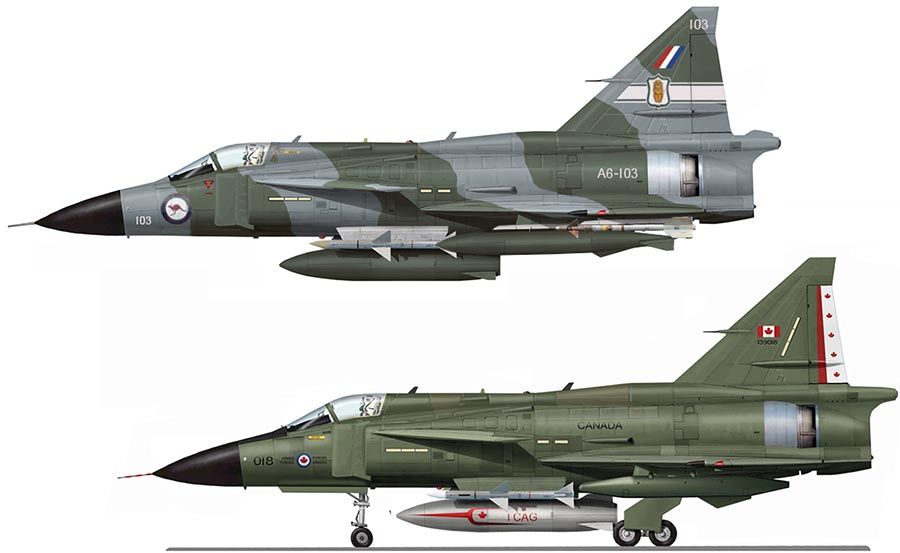
The 'A' in Thunderbolt 1(A) signified Attack. [7] Flying in a SEAD role, this aircraft carries AN/AGM-45 Shrike 'anti-radiation' missiles. For self-defence, AIM-9 short-range AAMs are carried on the outer pylons. This Thunderbolt 1(A) is carrying extra-long-range 'Darwin' tanks under its wings along with the usual centre-line drop tank.
Bottom: A Canadair-assembled SBCC CF-139 Thunderbolt of 439 Squadron while based at CFB Lahr in June 1980. Special 1 CAG markings have been applied for participation in NATO's 1980 Tactical Air Meet at Ramstein AB. For this exercise, '139018' is carrying MN-1A practice bomb dispensers (DOD SUU-21/A) on its inner wing racks in place of the usual paired BL755 cluster bombs.
This Thunderbolt is a Tranche 1 CF-139 assembled largely from Saab- or BAe-supplied components. As such, this aircraft lacked some diagnostic Canadian features - such as wing pylons plumbed for ferry tanks and braking chute housing. The scheme is an overall olive green which had proved highly effective on the Thunderbolt's CF-104 predecessors. [8]
___________________________________________
[7] To suit their attack role, the SBCC Thunderbolt 1(A) were finished in a wrap-around camouflage scheme. By contrast, the RAAF's Thunderbolt 1(F) fighter variant had sky-grey undersides.
[8] Not included in DND's 1-GP-12c binder, this ad hoc colour was designated as X-03-3. However, in service, this dark olive colour would generally be referred to as 'Prestwick Green' (in honour of its origins on contract-painted CF-104s).___________________________________
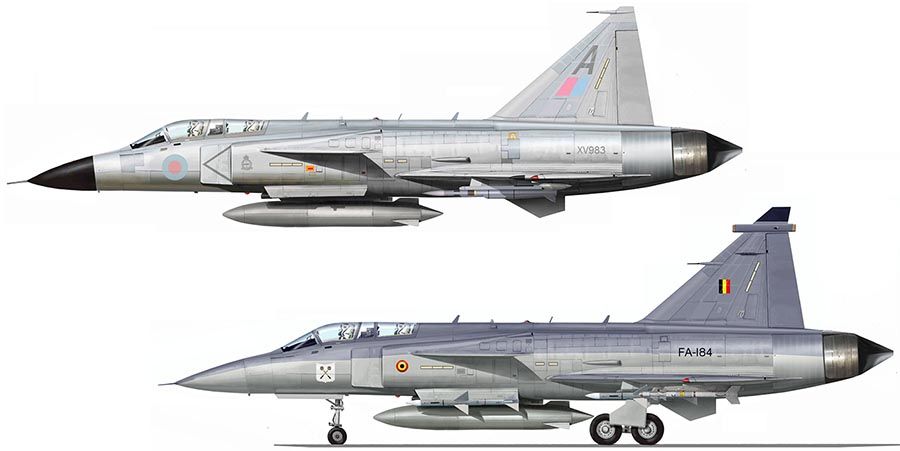
This Cyclone's external load consists of just two S225XR 'Skyflash 90' test missiles. Jointly developed by BAe Dynamics, Saab-Bofors, and France's Thomson CSF, S225XR would enter active service as the Skyfox, RB 73, and MADPV, respectively. [9] This wingless Skyflash development replaced the American solid propellant motor with an integrated rocket/ramjet. Skyfox 1 retained the Marconi seeker from Skyflash while Skyfox 2 introduced Thomson CSF's new active seeker.
Bottom: A Eurofighter F 37BE belonging to 349e escadille (or 349ste Smaldeel) of the Belgian Force aérienne's 1e Wing de chasse tout temps. [10] The darker camouflage scheme worn by all 'Cyclons' was dubbed 'à motif couvert' (or overcast pattern) and was matched with reduced-scale Belgian markings to reduce visibility. A 349e escadille crest is displayed on the forward fuselage.
Production SBCC and Eurofighter Cyclones could be readily distinguished from prototypes and pre-production aircraft by their fin-top radar warning antennae. 'Cyclon' FA-184 is armed with 6 x Skyflash medium-range missiles - two on the fuselage side pylons plus paired rails on the inboard underwing pylons. The distinctly Belgian self-defence armament consists of Matra R.550 Magic 2 short-range AAMs on the outboard pylons. [11]
___________________________________
[9] The MADPV (missile au-delà de la portée visuelle or Beyond Visual Range Missile) variant was tailored to Dassault's FCS since the French were not partners in either the SBCC or Eurofighter programmes.
[10] The 349e escadille returned to all-weather interceptor duties after almost two decades operating as a day fighter unit in the Quick Reaction Alert role.
[11] The Force aérienne F 37BEs incorporated SABCA's Matra Missile/Radar Integration Adaptation (MMRIA) to allow the R.550 Magic 2 to work with the Cyclone's fire control system.___________________________________
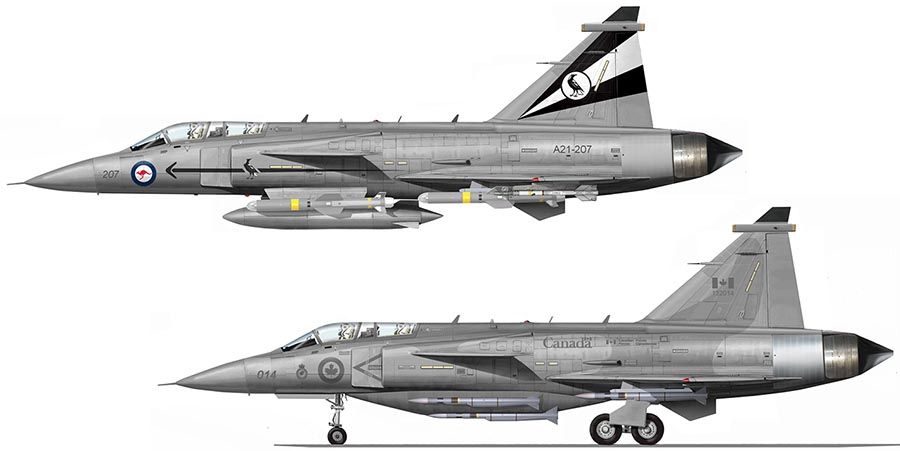
Other than its display markings, this Cyclone wears the standard RAAF all-over Air Superiority Grey camouflage scheme. For display purposes, full-colour roundels are worn. The airshow specific markings - both fin flash and fuselage arrow - depict the Magpie from 75 Squadron's badge.
Bottom: An SBCC CF-132 Cyclone of No 416 (Interceptor) Squadron which was home-based at CFB Chatham, NB. However, the CF-132 is seen here deployed north to CFS Iqaluit - a Forward Operating Location on Baffin Island, NWT. [12] It was for such operations in Canada's Far North that Canadair devised a CFT for the CF-132 which also provided weapon attachment points. [13]
This CF-132 wears the Canadian Forces standard 2-tone grey interceptor scheme of 501-322 patches atop all-over 501-323 paintwork. Most lo-viz markings are in Medium Gunship Grey FS 36118, others in 501-322. Following standard practice, the 'last two' of the CAF serial is displayed as an individual aircraft number on the nose. Between that 'buzz' number and the roundel is the 416 Squadron crest.
___________________________________
[12] Until 1987, Canadian Forces Station Iqaluit had been CFS Frobisher Bay.
[13] The CFT featured 2 x horizontal pylons and 3 x semi-recessed missile mounts for medium-range missiles - initially Skyflash, later Skyfox. As shown here, only 2 x semi-recessed mounts were normally used (the third was blanked off unless underwing ferry/ultra long-range tanks were employed).The Viggen/Thunderbolt/Cyclone program was going from strength to strength and soon other countries would join in.
First of all, in Europe there were two parallel programs in play for NATO members. The first of these was known as the Multi Role Combat Aircraft (MRCA) and was looking for a common strike aircraft to replace the F-10Gs in West German, Belgium, Netherlands, Norway and Denmark as well Italian service. Concurrent with this, many of the same countries were looking for a new tactical fighter to replace many different types. This requirement was highly sought after with types such as the F-16 and Mirage F.1 being offered. The SBCC consortium were obviously very interested and decided to pitch a strong bid for both needs with the SBCC Cyclone for the MRCA and the Thunderbolt for the Tactical Fighter. A key part of their offering was the establishment of production capacity in mainland Europe supported by many manufacturers in the countries involved. This would be managed by a new consortium, Eurofighter Aircraft GmbH, and include SBCC, Fokker, Messerschmitt-Bölkow-Blohm, Aeritalia and SABCA with two new production lines established (one for the Thunderbolt and the other for the Cyclone). This combined by the ability of the partners to benefit from economies of scale to offer a lower price than their competitors would see the Thunderbolt and Cyclone come out on top in 1975.
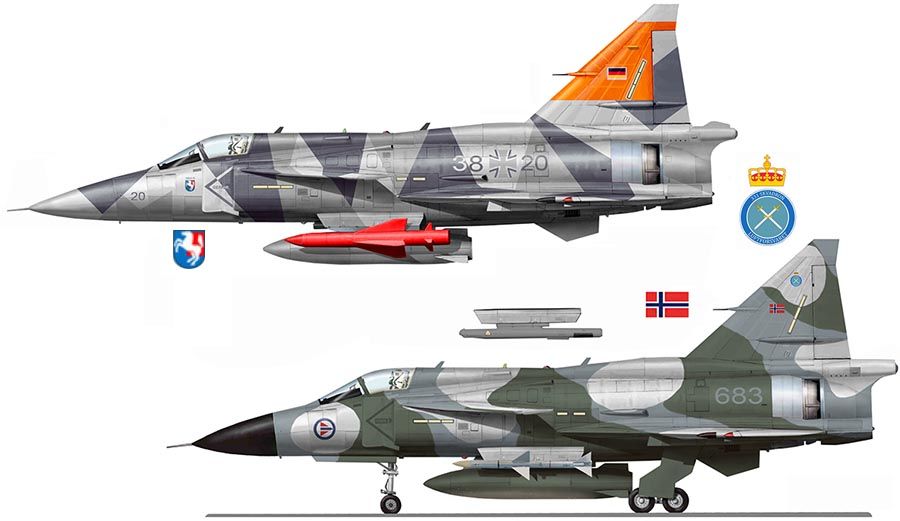
This AJ 37D wear an early, experimental low-visibility scheme of overall RAL 7030 Steingrau with an upper splinter pattern of RAL 7011 Eisengrau and RAL 7012 Basaltgrau - which extended into national and squadron markings. It was hoped to standardise this 'Grautöne' combo as a Normmuster. However, the scheme was judged unsuitable for low-level attack roles - except, ironically, over water.
Here, a pair of red-painted AS 34 Kormoran missiles are carried and large Dayglo panels have been applied to the fin - JaBoG 36 having been assigned the task of trialling that Marine ASM on the AJ 37D. The AJ 37D could carry twice the load of the Marine's F-104s. As a result, the Kormoran trials had a double prompt. Should Marine deploy AJ 37s? Or should the Luftwaffe take over the fast jet anti-shipping role?
Bottom: Kong, Folk og Fedreland... a Eurofighter Tordenbolt - the Norwegian name for the Thunderbolt/Viggen. [15] Tordenbolt 683 belonged to 330 skvadron RNoAF based at Bodø flystasjon in Nordland - but, here, as forward-deployed to Banak flystasjon in Finnmark. The Tordenbolt was a standard Eurofighter Thunderbolt other than having a braking chute and optional arrestor hook for icy runways as well as winter survival packs.
Vinterfrakk: This Toldenbolt wears temporary winter white camouflage over its temperate scheme. The Norwegians chose a scheme very similar to that of RAF Thunderbolts. However, having observed the effectiveness of wrap-around camo on visiting RAF Harriers and Jaguars, the Luftforsvaret decided to follow suit for its Toldenbolter.
This 330 Skvadron Toldenbolt is operating as an anti-radar 'gnisjeger' ('spark hunter') - armed with a AGM-45A Shrike on port fuselage pylon with the matching Westinghouse AN/AVQ-23E Pave Spike pod (also inset) to starboard. [16] Underwing, the 'gnisjeger' would normally carry a pair of Paveway II LGBs. On the outer port pylon would be a Westinghouse AN/ALQ 101 ECM pod, to starboard either a chaff dispenser or AIM-9P missile.
___________________________________________
[14] The Luftwaffe's new 'AJ' designator stood for Angriffsjäger (Strike Fighter).
[15] The Tordenbolts were direct replacements for old CF-104s and Canadair-built MAP F-104Gs which were phased out of Norwegian service in the winter of 1982.
[16] By 1975, the AVQ-23E was obsolescing. However, the Shrike still represented sufficient threat to force Soviet GBAD radars to be shut down. That would allow time for strike Tordenbolts to deke in. If, while Fan Song and the like were shut down, a Shrike struck a lesser air defence radar system which was still emitting, such collateral damage would be a bonus.___________________________________________
Over the coming years these and a number of further export sales would see total combined Viggen/Thunderbolt/Cyclone production reach in excess of 3000 aircraft with the following operating the types:
Sweden: 329 Viggens - Original Operator
UK: 120 Thunderbolts and 120 Cyclones - Original Operator
Australia: 60 Thunderbolts and 48 Cyclones - Original Operator
Canada: 180 Thunderbolts and 120 Cyclones - Original Operator
Germany: 175 Thunderbolts and 245 Cyclones - Eurofighter Partner
Italy: 246 Thunderbolts and 100 Cyclones - Eurofighter Partner
Belgium: 160 Thunderbolts and 60 Cyclones - Eurofighter Partner
Norway: 74 Thunderbolts - Eurofighter Partner
Denmark: 78 Thunderbolts - Eurofighter Partner
Netherlands: 213 Thunderbolts - Eurofighter Partner
Switzerland: 28 Thunderbolts - Export Sale
Austria: 48 Thunderbolts - Export Sale
Finland: 54 Thunderbolts - Export Sale
India: 160 Thunderbolts - Export Sale/Local Production
Saudi Arabia: 120 Thunderbolts - Export Sale
Malaysia: 12 Thunderbolts - Export Sale
Greece: 40 Thunderbolts - Export Sale
Spain: 45 Thunderbolts - Export Sale
Portugal: 28 Thunderbolts - Export Sale
Taiwan: 54 Thunderbolts - Export Sale
Singapore: 60 Thunderbolts and 40 Cyclones - Export Sale
Over the years various updates/modernisation packages were incorporated, mostly to the avionics and engines and to the weapons able to be carried. One common update that a number of Cyclone operators (Germany, Italy, UK, Belgium and Australia) was to adapt a number of their aircraft to an electronic attack/Suppression of Enemy Air Defence (SEAD) role through the incorporation of appropriate electronics and the ability to carry either AGM-88 HARM or ALARM missiles.



