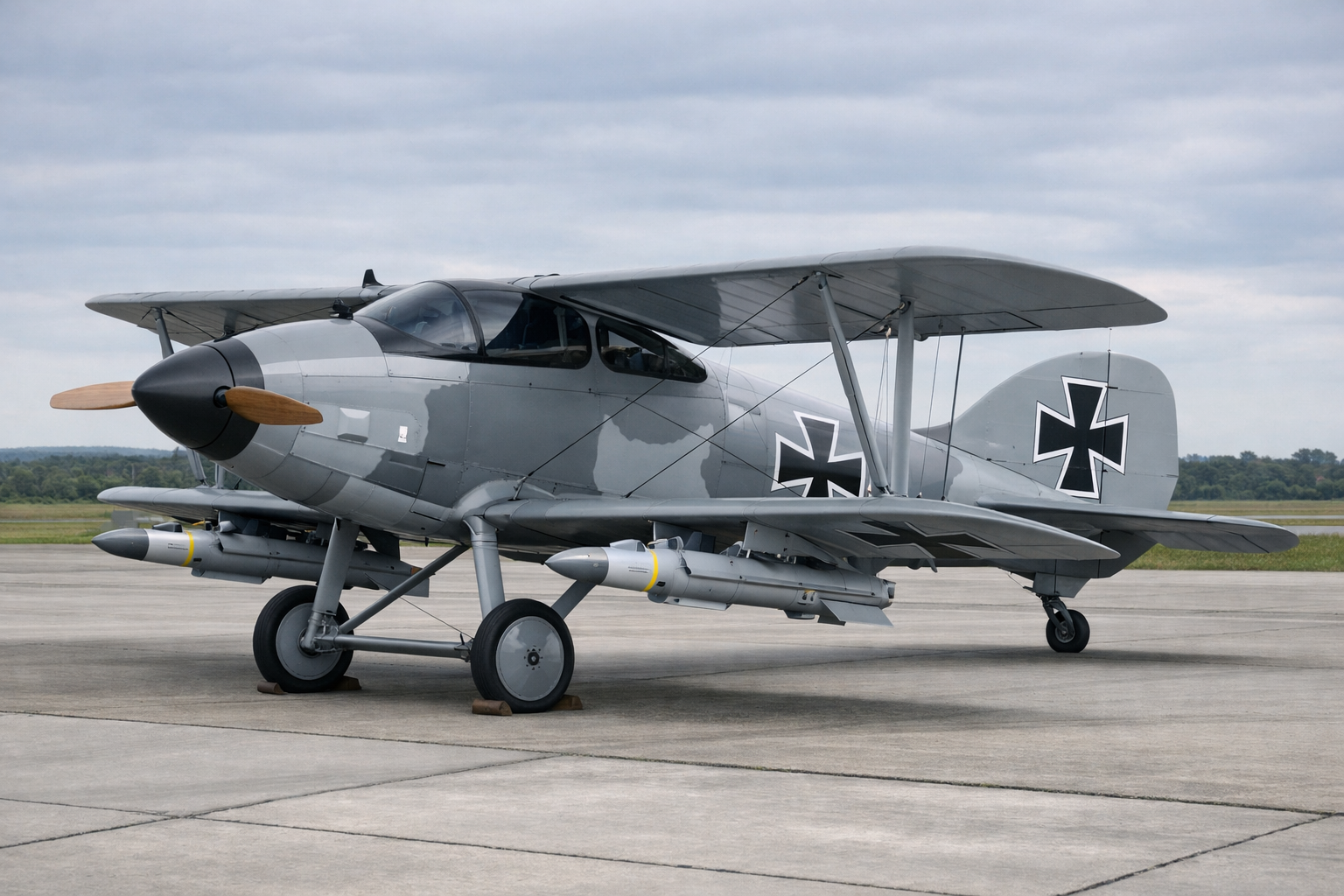
Stinging Cobras Most histories of the Bell P-39 Airacobra consider it to have been somewhat of a failure as a fighter. This despite nearly 10,000 being produced and it servicing with 8 air forces in virtually all theatres of WW2. The USSR in particular used the type to great success as a fighter throughout the war. Indeed, half of the 10 highest-scoring Soviet aces logged the majority of their kills in P-39s and the last Soviet air victory was in a P-39 on 9 May when Kapitan Vasily Pshenichikov downed a Focke-Wulf Fw 189 over Prague.
That said, this story looks at two of the lesser reported users of the P-39. Both of these were unique in using the type in the anti-tank role, a role the P-39 was never originally considered for.
Royal Air Force: In 1940, the British Direct Purchase Commission in the US initially ordered 675 of the export version Bell Model 14 as the Caribou. The British armament was two nose-mounted .50 caliber machine guns and four .303 calibre Browning machine guns in the wings. The 37 mm M4 cannon was replaced by a 20 mm Hispano-Suiza cannon. However, after the first Airacobras arrived at 601 Squadron RAF in September 1941, they were found to have an inadequate rate of climb and performance at altitude for Western European conditions. After only a month, the type was replaced by Supermarine Spitfires.
While an effort was made to cancel the order, the RAF now found itself with approximately 200 of a type it did not want. Most of these would be on sold to the USSR and find a welcomed operator there. Some 30 were still on RAF books though. Not knowing what to do with these, at first it was considered to just use these in a training role. Soon however, a new role was found that would prove perfect for the P-39.
In December 1941, trial would be conducted with a new idea, that of fitting the type with a 40mm cannon for an anti-tank role. This was not radical as one might think given the P-39 was originally fitted with the 37mm M4. The weapon in question though was a much larger gun, being some 54% heavier and some 30% longer than the M4. The new gun in question was the 40 mm Vickers S gun. This was originally developed in the late 1930s as defensive weapon for bomber aircraft.
Early operations by the Desert Air Force in the North Africa campaign had demonstrated that existing weapons were ineffective against newer German vehicles like the Panzer III medium tank. In April 1941 a group formed to study the issue, considered a series of 37 and 40 mm weapons including the "S", the Rolls-Royce cannon (belt fed variant), and the US-built M4 autocannon (as originally fitted to the P-39), all firing armour-piercing ammunition. After a series of trials, the decision was made to introduce ground attack variants of the P-39 with the "S" gun. This weapon proved to have between 50 and 120% greater armour penetration ability than the original M4. These were loaded with 30 rounds but because of the weight and balance concerns of the different weapon were also fitted with additional armour plate in the nose area. This was not a bad thing though as although the additional weight reduced the P-39’s performance, in the ground attack role, the additional armour was welcomed.
In service, all were initially delivered to No. 6 Squadron starting in April 1942. Previously this unit had operated the Westland Lysander and Gloster Gladiator so the P-39 was still a major step up. The squadron moved up to RAF Gambut on 4 June 1942 for operations, flying its first combat operations on 7 June and the next day claimed one tank destroyed and several other vehicles damaged. The squadron took part in the Second Battle of El Alamein in October–November 1942 and continued to prove very effective in destroying German and Italian tanks. That said, it did prove to be vulnerable if intercepted and thus it was common for the type to be escorted by other RAF fighters when in action. The nature of the P-39 ground attacks also saw them exposed to ground fire and losses were common.
The squadron was eventually withdrawn after the end of the fighting in North Africa both due to the losses and the fact that it was becoming logistically challenging to keep the remaining P-39s flying. In July 1943 the squadron returned to operations, this time with the new Hawker Typhoon which could be armed with rocket projectiles.
Top: Bell Airacobra IA in service with No. 601 Squadron RAF in the Western Desert. AH560 has the later, standardised unit markings - with 601's winged sword on the nose and the individual aircraft letter - 'L' - relocated behind the roundel.
Bottom: Airacobra IA AH543 while on loan to to No. 103 MU at Aboukir. This aircraft has its individual aircraft letter - 'E' - in the original, forward position. No. 103 MU modified AH543 with twin exhaust grills to help vent cordite fumes from the Vickers S gun. A large housing for a Vokes Aerovee air filter was also devised at Aboukir. Neither No. 103 MU mod would be adopted for the Airacobra fleet. Ilmavoimat: On 30 November 1939, the USSR attacked their neighbour Finland. Thus, started what would become known as the “Winter War”. At this stage, the Ilmavoimat (Finnish Air Force) was equipped with only 18 Bristol Blenheim bombers and 46 fighters (32 modern Fokker D.XXIs and 14 obsolete Bristol Bulldogs). Despite this, they gave a good account for themselves.
As the war progressed, the Finns tried desperately to purchase aircraft wherever they could. This effort had actually commenced months earlier. One of the types considered was the new Bell P-39 Airacobra and in December the Finnish government signed a contract to purchase 44 aircraft. The first of these would not arrive until after the war ended in mid-March 1940. That said, they were still quickly introduced into operations. One of the particular aspects that attracted the Finns to the type was its heavy hitting 37mm M4 cannon. This came with M80 armour-piercing rounds thus providing the Ilmavoimat with a dedicated flying anti-tank capability.
On 25 June 1941, Finland joined Germany in declaring war on the USSR, thus commencing what would become known as the Continuation War, or the Second Soviet–Finnish War. This time the P-39s were ready and used in combat from the very start and were active in both the air-to-air role and the air-to-ground role. In the latter, they proved especially effective against Soviet tanks, even the more modern ones such as the T-34 and KV-1, although these did require careful targeting of the rear or top surfaces where the armour was thinner.
The P-39s continued to be used for some time until replaced in the air-to-air role by Bf 109s supplied by Germany in 1943. From this point the P-39s concentrated on the air-to-ground role and were flying with armour-piercing rounds at all times. The intensity of the action would soon see the M4 guns wearing out and also the precious M80 rounds running out. By that time the USA had entered the war thus precluding any chance of further resupply. As such, the Finns had to consider upgrading the P-39s and replacing the beloved M4 cannon. After looking at the German 37mm Bordkanone 3,7 and deciding that it was just too big and heavy to install in the P-39 (the German gun was some 200% heavier and 65% longer than the M4), it was decided to introduce another German gun, the 30mm MK 103. Although still larger than the M4 (it was only 45% heavier and 3% longer) the new gun was able to be installed into the P-39. Some additional armour plating was fitted in the nose are to help with the weight and balance. This was also useful given the environment the type acted. The new cannon was also much more powerful able to deliver 70 – 80% greater armour penetration, thus enhancing the type's ability to attack the latest Soviet tanks.
The type would continue to be used by the Ilmavoimat for the remainder of the war. One of the more interesting aspects was that due to the USSR also flying the P-39, the Finnish pilots were able to take advantage of this and when approaching from the rear of the Soviets were able to surprise their targets who mistakenly thought they were friendly forces.
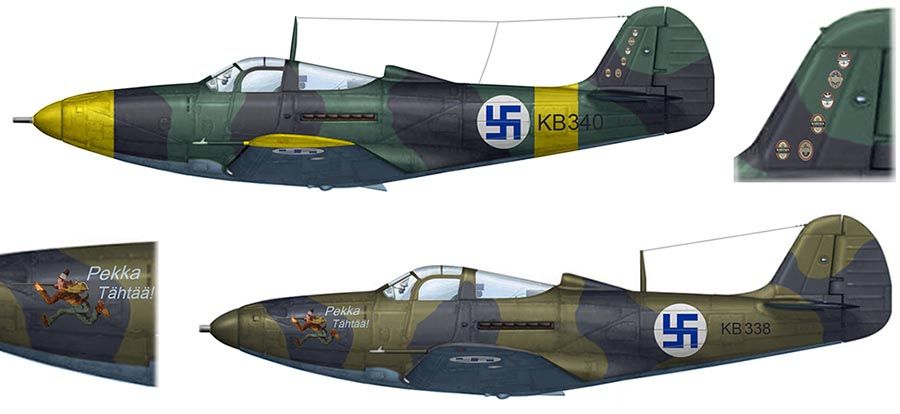
Top: Ilmavoimat Bell Kobra-S of Lentolaivue 32 in Karelia in late Autumn of 1943. 3/LLv 32 had begun receiving refurbished Airacobras in the Summer of that year. The longer gun barrel protruding from the propeller hub reveals that KB330 has been re-armed with the German MK103 30mm cannon - that 'S' in Kobra-S standing for Saksa ('German). KB330 is shown freshly painted but its tail fin has already been festooned with beer bottle labels. Those labels indicate that pilot lentomestari Eino Koskinen claimed at least six Soviet tank 'kills'.