From Racer to Patrolling Warhorsein 1934 the England-Australia MacRobertson Air Race from the United Kingdom to Australis was won by the specialised de Havilland DH.88 Comet two-seat, twin-engined aircraft. This was the first British aircraft to incorporate in one airframe all the elements of the modern high-speed aircraft - stressed-skin construction, cantilever monoplane flying surfaces, retractable undercarriage, landing flaps, variable-pitch propellers and an enclosed cockpit. Three Comets were produced for the race, with G-ACSS Grosvenor House eventually winning the race and another, G-ACSR, coming in forth. Grosvenor House was dismantled and shipped back to England where it was purchased by the Air Ministry, given the military serial K5084, painted silver overall with RAF markings and flown to RAF Martlesham Heath for evaluation by the Aeroplane and Armament Experimental Establishment.
The outcome of this evaluation was a recommendation that de Havilland be asked to propose a military version of this. Specification F3/35 was quickly drafted for this and sought a long-range fighter with a secondary photo reconnaissance capability. The specification was essentially written around the Comet design emphasising range and heavy, for the time, armament. Two crew were required with the second being a dedicated observer/radio operator/navigator but who would also be able to fly the aircraft if need be. The expectation was that the resulting aircraft would fly long endurance patrols far from home and be able to provide a hard-hitting punch able to take out bombers and other large aircraft. It would also be able to report on observed attacking aircraft and be able to coordinate other interceptors as required. Secondary roles would include long range escort duties, for both bombers and naval ships as well as the ability to replace armament with a set of cameras for reconnaissance.
de Havilland responded quickly with the DH.88B Comet Mk.1F with the first of these delivered in mid 1935. The basic design was essentially identical to the earlier racer versions. The changes included replacing the front fuel tank with a pair of 0.303-in (7.7-mm) Browning guns along with a single heavier weapon. Initially this third weapon was to be a forward firing Coventry Ordnance Works (COW) 37 mm automatic cannon with 40 rounds of ammunition however after initial trials, it was soon discovered that the weight and recoil of this weapon was causing problems. Alternates were soon identified with the first being a single 0.50 in (12.7 mm) M2 Browning machine gun with 200 rounds of ammunition. Another option trialed was a 20 mm Oerlikon FFS autocannon with a 60 round drum magazine. Both options were used in service with the M2 being the more common. Another option trialed was just an additional pair of 0.303-in Browning guns. In the photo reconnaissance role, the guns were replaced with two oblique cameras.
Obviously, the removal of the forward fuel tank reduced the range but even with this, a respectable range of 1870 mi (3009 km) was still possible. Moreover, a top speed of 237 mph (381 km/h) was still possible. To place this in context, the new Gloster Gauntlet delivered only a couple of months earlier, only had a range 460 mi (740 km) and a top speed of 230 mph (370 km/h). Moreover, it only carried a pair of 0.303 in Vickers machine guns.
The first operational Comet Mk.1F fighters were delivered to No.64 Squadron in November 1935. The squadron returned from Egypt for this and was subsequently transferred to be part of the UK air defences. Eventually another 200 would be acquired serving with 10 squadrons. In service, the Comets were used as a first line of Defence for the UK, conducting long range/endurance patrols far from home. They also conducted a number of visits to mainland Europe in the late 1930s, in part to send a message of deterrence to the growing forces in Germany. In some respects, it was claimed that these shows of force inspired others to also develop the heavy, twin engined fighter concept with designs such as the Messerschmitt Bf.110, Potez 630 and Fokker G.1 all claimed to have been inspired by the type, though in defence of their designers, all of these types can trace their development to before the de Havilland product entered service.


Little changed from its racing days, K5084 retained its original Gipsy Six "R" engines - each producing 223 hp @ 2,400 rpm for takeoff. Her scheme was the then-standard RAF all-over silver dope finish with Type A roundels in six positions. The flat black anti-glare panel ahead of the cockpits was a later addition.
Bottom: Acting as an armed Comet fighter prototype was another MacRobertson Race participant - formerly the Mollison's G-ACSP 'Black Magic'. DH recovered this aircraft stranded by engine failure at Allahabad. She was then restored with standard Gipsy Six Series II engines driving Ratier variable-pitch propellers. A representative pair of Colt-Browning machine guns were installed in the upper nose for firing trials but K5062 never did receive a third weapon.
After operation by A (Gunnery) Flight of the RAF's A&AEE at Martlesham Heath, the prototype Comet K5062 was rebuilt as the sole Comet Mk.IT dual-control conversion trainer. Here, K5062 wears the disruptive camouflage first applied in early August 1938. Type B roundels mark the fuselage sides and upper wing surfaces.
____________________________________________________Alas, the efforts to prevent the coming war in Europe were doomed to fail with the German invasion of Poland on 1 September 1939 and resulting British and French declarations of war on Germany two days later resulting in Europe once again being at war. The Comet would soon see action with a No. 145 Squadron Comet intercepting and shooting down a Luftwaffe Dornier Do 18 flying boat over the North Sea on the 4th September. Over the coming months a few more kills were achieved, mainly of German long range patrol or reconnaissance aircraft.
Developments moved fast with aircraft though and what in 1935 was cutting edge, by 1940 was no longer so. The Comet was one such example with heavier, more capable types, such as the Bristol Type 156 Beaufighter entering service in mid 1940 and offering far greater capability. The Comet also had proven that whilst extremely capable when operating in an unopposed long range role, was less capable when facing opposing fighters. This was first shown over Norway in April 1940 when RAF Comets came up against Luftwaffe Bf.110s and more so, Bf.109s. The Comet just wasn’t built for aggressive dogfighting.
During the Battle of Britain later in the year, Comets were largely kept from the main battle, instead being used to either provide early ‘trip wire’ warnings of incoming armadas or more often than not, patrolling the North Sea and other areas far from the main battle to prevent sneak attacks.
The Comet would however find itself in the thick of action again in early 1941 when a few were equipped with AI Mk. IV radar. The long endurance of the Comet along with its two seat configuration with the Navigator now being tasked with operating the radar. In this role, the Comet Comet Mk.II NF as they were designated achieved multiple kills, once again proving itself capable. In this role though the type was once again overtaken by types such as the Beaufighter. Eventually the Comets were delegated to long range convoy escort and Air-Sea Search and Rescue missions. Even int his role the type excelled, with Comets managing to shoot down seven Luftwaffe Focke-Wulf FW 200 Condor Maritime Patrol/Reconnaissance aircraft.
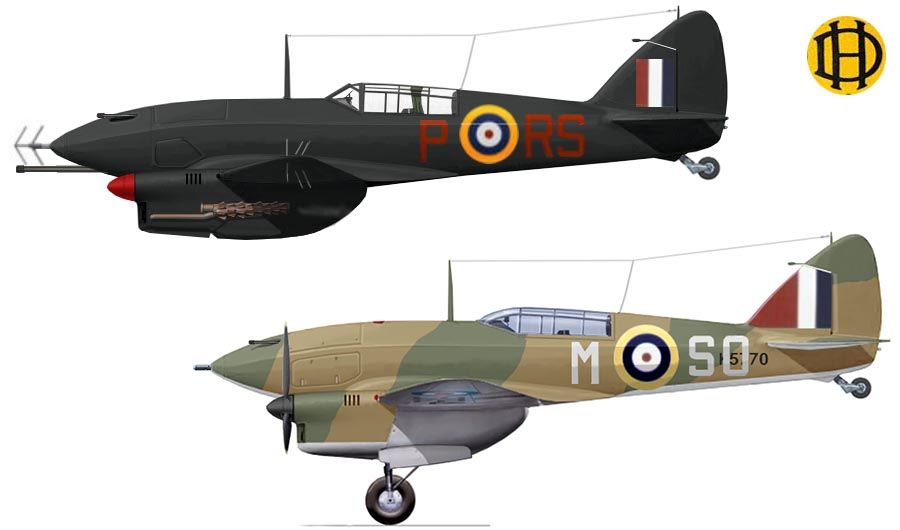
Differences for the production Comet Mk.IF included full armament of twin .303-inch Brownings plus a single .5-inch gun in the nose. The latter displaced the original nose-cone landing-light (which was relocated to the starboard wing). Powerplants were now supercharged, 240 hp Gipsy Queen IIIS engines driving 3-bladed, variable-pitch DH Hydromatic propellers. [1]
Other production changes were a shift from main undercarriage aprons to less drag-inducing hinged doors and replacement of the tail skid with a swivelling tail wheel. Just after the outbreak of WW2, the Comet Mk.IF fleet was progressively fitted with radio transmitters - as shown here.
Top: A de Havilland Comet Mk.IINF of No. 157 Squadron based at RAF Debden, Essex, in early 1941. This squadron was reformed in Jan 1941 specifically to operate the 'Night Comet'. The overall finish was a well rubbed-down satin black [2] with night bomber-style dull red squadron codes. Comet II K8632 was rather short-lived, being lost to Luftwaffe defensive fire off Clacton-on-Sea on the night of 10-11 March 1941.
Detail differences between the Comet Mk.IINF and Mk.IF were a revised 'big gun' mount for the 20 mm British Hispano Mk.II cannon and a long-delayed armour glass windscreen installed as standard. Specific night-fighting equipment shown are 3 of the 5 sets of Yagi antennae for the AI Mk.IV radar and the rather complex exhaust system incorporating glare suppressors.
__________________________________________
[1] Beyond its supercharger, the ability to accommodate variable-pitch propellers further distinguished this 'IIIS from the base Gipsy Queen III. This propeller change improved performance but, in reality, the substitution was prompted by fears of disrupted deliveries of Ratier VP units from France.
[2] RAF policy of the time dictated a very matte 'Lamp Black' finish for night fighters. However, de Havillands successfully argued that Mk.IINF performance would become marginal with such a rough finish. Accordingly, an exception was granted for the 'Night Comet' which received glossy paint which was then hand-rubbed to create a smooth, 'satin' finish.__________________________________________
The last Comet was retired in mid 1944.



