Swiss StilettosDuring the 1950s, the Swiss Air Force purchased several jet fighters including the de Havilland Vampire, de Havilland Venom and Hawker Hunter. During the same time the Swiss government also experimented in development and production of its own jet fighters, the FFA P-16 and the N-20 Aiguillon, but it was not satisfied with them. By the middle of 1958, influenced by NATO concepts, the National Defense Commission (LVK) had redefined the Swiss doctrine of air power from close air support to counter-air operations. Furthermore, the strategic concepts governing Swiss defense doctrine had shifted to one that included execution of air missions beyond the Swiss border and the possibility of carrying nuclear weapons, either of Swiss or French design.
As the 1960s dawned, the Swiss faced a dilemma of needing to support both its ground forces and to deploy an air-to-air capability. While the best Swiss fighter, the Hunter, could provide some counter-air defense over a battlefield and escort ground-support fighters, it was not supersonic nor was it believed capable of defending Swiss airspace. Thus in 1961, a program to acquire a new fighter was commenced. The goal was to produce the selected type under licence in Switzerland with up to 100 to be produced. At the time, all the leading types in service with, or entering service, with Western Air Forces were looked at including: the English Electric Lightning, Dassault Mirage III, Lockheed F-104, Saab Draken, Northrop F-5, McDonnell F-4 Phantom II and Grumman F11F Super Tiger. All were superb aircraft and all offered their own individual strengths and weaknesses.
Eventually, in 1962, the Swiss Government announced the selection of the F-104 Starfighter as its new fighter. This was not a surprise to anyone given how the type was already becoming dominant elsewhere in Europe with the Air Forces of Belgium, Denmark, West Germany, Greece, Italy, Netherlands, Norway, Spain and Turkey all having selected the type.
The variant selected by Switzerland was based upon the same F-104G as selected by the other European operators but wasn’t quite identical. While it still had the same strengthened fuselage and wing structure, increased internal fuel capacity, enlarged vertical fin, strengthened landing gear with larger tires and revised flaps for improved combat manoeuvring of the F-104G, it was further improved with its NASARR R-21G/H radar upgraded for the interception role with moving target indicator and continuous wave illuminator for SARH missiles, two additional wing and two underbelly hardpoints (to give a total of nine), uprated J79-GE-19 engine with 52.8 kN (11,870 lbf) thrust (79.6 kN/17,900 lbf with afterburner), and two additional ventral fins for increased stability at high Mach numbers. Up to two AIM-7 Sparrow; and two, theoretically four or six, AIM-9 Sidewinder missiles could be carried. The 20mm M61 Vulcan was sacrificed though. It could also carry up to could carry up to seven 227 kg (500 lb) or 340 kg (750 lb) bombs, an improvement over the F-104G, which could lift only half that on five hardpoints, two of which were needed for auxiliary tanks. Theoretically, the new version could be equipped with four or five bombs, two drop tanks, and two AIM-9s, becoming a dual-role aircraft. The new variant was designated as the F-104S.
Also procured were a number of TF-104S combat-capable trainers and a tactical reconnaissance model, the RF-104S usually with three KS-67A cameras mounted in the forward fuselage.
The F-104S were manufactured in Switzerland by F+W Emmen and would perform the attack, interception, and reconnaissance missions with Fliegerstaffeln 1, 2, 3, 4, 5, 6, 7, 8, 10, 16 and 17. The Patrouille Suisse aerobatic team also flew the type. In service, the type quickly gained the nickname of “The Stilleto” due to its shape and resemblance to the specialised dagger/stabbing weapon.
Speaking of specialisation, the F-104S were typically operated from air bases hidden within caverns in the mountains that Swiss Air Force used as bunkers. To enable the type to have a short takeoff and landing (STOL) capability, JATO-assisted takeoffs were also able to be undertaken. Even more extreme though was the decision to have some aircraft fitted to be launched using the zero-length launch system (ZELL). This was first developed and trialled by the Americans and Germans and entailed using massive rocket boosters to launch the supersonic interceptors directly from hidden, mobile pads or, in the case of the Swiss, mountain bunkers without the need for vulnerable runways. The plans originally involved a combination of such with either a F-104S fully loaded for the interception role or with a Swiss-built or French-built nuclear bomb. In the event, the programme to produce a Swiss nuclear bomb was stopped in the pre-production stage and Switzerland chose not to purchase such weapons from France either. As such, after a few years, the interceptor versions were also changed to more conventional takeoffs.
The F-104S would continue in operation for the next 25 – 30yrs. In the early-mid 1980s they would be upgraded to F-104S-AW (Aktualisierung der Waffensysteme - Weapon Systems Update) standard with upgraded with AN/APG-68 radar (from the F-16) with look-down/shoot-down capability, new IFF and weapons delivery computer, and provision for AIM-9L all-aspect Sidewinder and British Skyflash missiles.
The F-104 would continue in Swiss service until the mid 1990s. In the late 1980s changing political and military world situations implied the need for multirole aircraft in the Air Force. After evaluation, and paralleling the earlier decision to follow other European air Forces, the Swiss decided to purchase the F-16C/D to replace the type. Between 1996 and 1999, 54 licence-built F-16s left the assembly lines at Emmen. The last Swiss F-104 would fly on 17 Oct 2003, thus marking the end of the Swiss Stilletos.
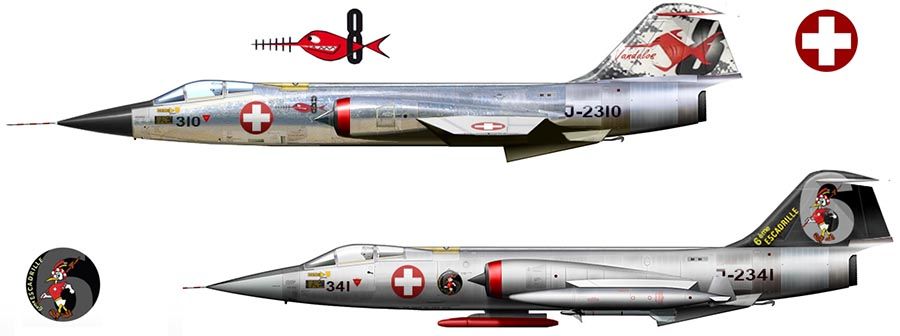
Aside from its air show markings, J-2310 essentially wears the standard Swiss F-104S bare metal scheme. This included 8 x roundel positions (although the vertical tail roundels are obscured here by air show livery); red recognition panels on the air intakes; an individual Jägernummer on the rear fuselage; and the 'last three' repeated on the nose. At some point in its career, this first tranche Stilett has received an all-black replacement radar radome.
Inset: 'Vandalo' - a variation on FlSt 8's snarling sawfish emblem. The application of this emblem to the forward fuselage was only for the during of air show season.
Bottom: An F-104S of Fliegerstaffel 6 (6ème escadrille) [2] from Payerne air base
in the French-speaking canton of Vaud in western Switzerland. This F-104S also wears special air show markings on its vertical tail. However, unlike the FlSt 8 aircraft (above), here, J-2341 is carrying missiles.
On the underwing pylon launchers are older Flz Lwf LL 63/80 ‘SIWA’ missiles - the Flugwaffe designation for export-model AIM-9P-3 short-range AAMs. On its second, belly Sidewinder pylons, twin air show smoke generators are mounted.
Inset: -- "Jusqu'au bout..." (To the bitter end ...) - a variation on the FlSt 6 emblem complete with marching duck in Swiss pikeman's garb.
_____________________________________________
[1] FlSt 8 forms part of Fliegergeschwader along 13 with Fliegerstaffel 11. The unit nickname «Vandalos» means Vandals or Destructors. But is also the name of the squadron's sawfish mascot. The term 'Schlüpfrig Stilett' refers to a Slick (or Slippery) F-104S Stiletto.
[2] The 6ème escadrille forms part of Fliegergeschwader 13 along with FlSt 11.
Both images are based on an original CF-104 profile by Lieuwe de Vries (although J-2310 has been largely 're-skinned').
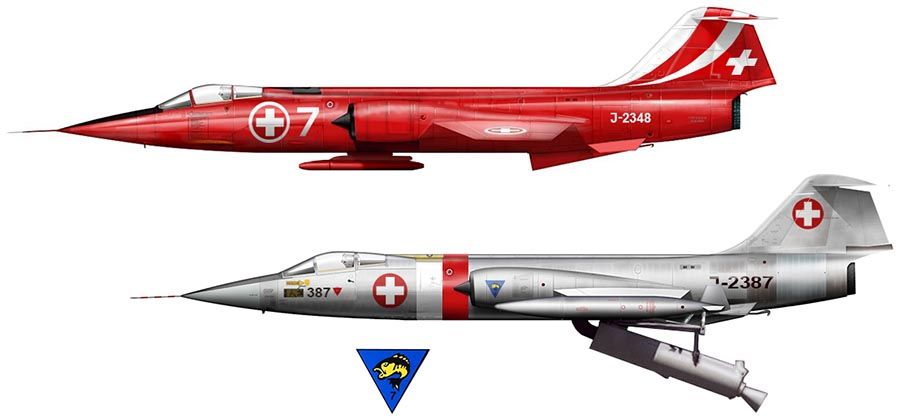
The Patrouille Suisse air show smoke system had three major components. Nozzles pressure sprayed paraffin oil (kerosene) down into the hot engine exhaust where it vapourised to produce a plume of white smoke. This plume was flanked by twin trails of red smoke issuing from dedicated smoke generator pods mounted on the belly missile pylon.
Bottom: Wir jagen! An F-104S of Fliegerstaffel 7 from Meiringen air base. This aircraft displays the FlSt 7 crest on its intakes. Ever on high alert, FlSt 7 fighters operate from within aircraft Höhle - caverns dug into the hillside rock at Meiringen (along with ammunition storage).
Some FlSt 7 pilots were trained for rocket-assisted launches - either with RATO or the even more dramatic FSSNl (Flugzeugstartsystem mit Nulllänge). [4] Using the latter, F-104S could be launched directly from within their Meiringen Höhlen. This aircraft carried special FSSNl markings - the white/red stripes on its forward fuselage. But, being prepared for an FSSNl test-launch, J-2387 carries no armament.
Inset: A close-up on 'Jaqueline' - FlSt 7's jumping yellow trout emblem.
_____________________________________________
[3] This image is based upon a Ugo Crisponi profile of an all-red AMI F-104S
[4] The Flugwaffe's FSSNl was based closely on the US/West German ZELL (ZEro-Length Launch) system - Flugzeugstartsystem mit Nulllänge basically being a direct translation of ZELL.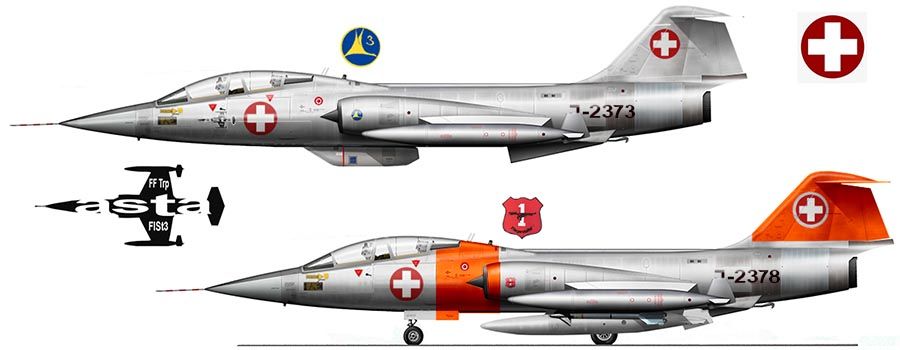
Delivered in bare metal finish, Aufklärer aircraft never had the red reco panels added (to reduce their visibility at low-level). As such, the scheme on J-2373 appears rather sparse. However, a small FlSt 3 crest has been applied to the intakes and, beneath the forward cockpit, is the Aufklärers' ASTA marking.
Bottom: Most 2-seat F-104S(SE) aircraft had full trainer markings applied soon after delivery. Although potentially fully operational fighters, higher-visibility markings were judged necessary for fast, low-flying trainers. As such, day-glo orange panels were applied to the forward fuselages and tailplanes.
This aircraft was assigned to Fliegerstaffel 1 at Militärflugplatz Turtmann in southern Switzerland. Here, the 2-seat F-104S(SE) has been armed with a quartet of underwing Flz Lwf LL 63/84 ‘SIWA’ Sidewinder missiles while engaged in an air exercise.
Inset: A larger version of that ASTA (Aufklärer STArfighter) logo. [6] Also shown are the units crests for 3ème escadrille (a high-stylised falcon) and FlSt 1 (with its Vogel Rok mascot).
_____________________________________________
[5] Swiss Aufklärer single-seaters were delivered with built-in KS-67A cameras fairings under their forward fuselages but 2-seaters were not. Fitting the older, fully external VICON pod was the Flugwaffe's work-round for those F-104S(SE) assigned to recce squadrons.
[6] Virtually all recce F-104S wore a variation on this ASTA design somewhere on their airframe. Note that, on this aircraft, the 'last three' have been relocated to the nose wheel doors. Note too that F-104S(SE) assigned to Aufklärer units, retained their 'J' serial suffixes.
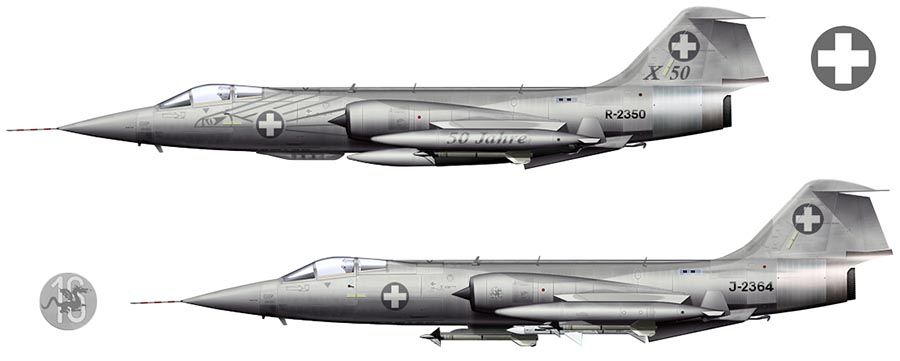
As an Aufklärer (recce) unit, FlSt 10 aircraft carry only self-defence weapons - in the form of underwing Flz Lwf LL 63/84 ‘SIWA’ (AIM-9L) short-range AAMs. Just discernible is the original F-104S(A) Trimetrogon belly pod with its 3 x J. A. Maurer KS-67A cameras. Note too that dedicated Aufklärer aircraft such as this worn 'R' prefixed serials rather than 'J-for-Jäger'. [7]
Bottom: An F-104S-AW fighter of Fliegerstaffel 16 (16e escadrille) from Sion air base in the Rhône valley (canton of Valais) in SW Switzerland. Compared with FlSt 10, the markings are quite restrained. Only a small unit crest on the inlets disrupts the 2-tone LÜLG camouflage.
As an interceptor, this 16e escadrille aircraft is heavily armed - with Flz Lwf 84 (Skyflash) medium-range missiles and short-range Flz Lwf LL 63/84 ‘SIWA’ under the wings with another pair of 63/84 (AIM-9L Sidewinders) slung beneath the fuselage. [8]
Inset: 16e escadrille's 'dragon avec bressumer' ('dragon with firebeam') emblem.
_____________________________________________
[7] The 'R-for Reconnaissance' in R-2350's serial may seem an odd choice. Why the Flugwaffe chose this instead of 'A-for-Aufklärer' is unknown. Still, it would have made perfect sense to French-speaking Flugwaffe personnel.
[8] For the record, Flz Lwf stood for Flugzeug Lenkwaffe or Aircraft Guided Weapon. LL was for Lenkwaffe Lenkung - referring to an actively steered guided missile. (That somewhat redundant LL ending later being dropped from Flugwaffe use.)
For attack, the F-104S-AW would retain the under-fuselage Sidewinders for self-defence but the wing pylons would be loaded with TABO 79 cluster munitions or paired 400 kg Sprengbombe. (TABO stood for Tiefabwurf-Streubobe or low-drop [munition] spreader. The former remained in service until Switzerland signed the Convention on Cluster Munitions.)



