Delta DuexIn July 1961 the Armée de l'Air (AdA) introduced the superb Dassault Mirage IIIC Interceptor. This was a major upgrade from the previous Dassault Mystère series offering Mach 2 performance and air-to-air missiles. Typical armament was a single Matra R.530 missile along with AIM-9B (initially) or Matra R.550 (later) missiles and a pair of DEFA 30mm cannon.
Although offering as major upgrade in capability for the AdA, it was soon observed that the limited weapons load potentially restricted the ability of the interceptors to deal with potential massed Soviet bomber attacks. Although one obvious option here was to simply deploy more fighters, the AdA also asked Dassault to offer options able to carry more weapons, thus offering more engagement endurance. Loading up the existing Mirage III design, even if given a more powerful engine, was not really practical. As such, the Dassault team looked to the obvious solution: developing an interceptor version of the new Dassault Mirage IV bomber.
The resulting Mirage IV-I (Intercepteur) was based on the existing Mirage IVA bomber. It removed the bombing/navigation radar and added in a Thomson-CSF Cyrano interception radar in the nose instead (using the space freed under the fuselage for more fuel). As far as weapons goes, the new IV-I still used the same basic weapon types but expanded the load out. Instead of the typical single Matra R.530 and twin Matra R.550/AIM-9s, the new type now carried 4 Matra R.530s and at least a pair of Matra R.550/AIM-9s (sometimes these were increased to 4 missiles). Moreover, typically the R.530s were carried in combinations of IR and SARH guided and were fired in pairs ‘Soviet’ style. A pair of 30mm DEFA cannon were also carried though it was expected that these would rarely be used.
The AdA were pleased. This matched exactly what they were after with missile load out at least doubled. Moreover, the use of a dedicated weapon system officer (WSO) to control the interception and the use of both IR and SARH missiles in tandem increased the probability of kill significantly. An order of 60 of the new Mirage IV-I was placed.
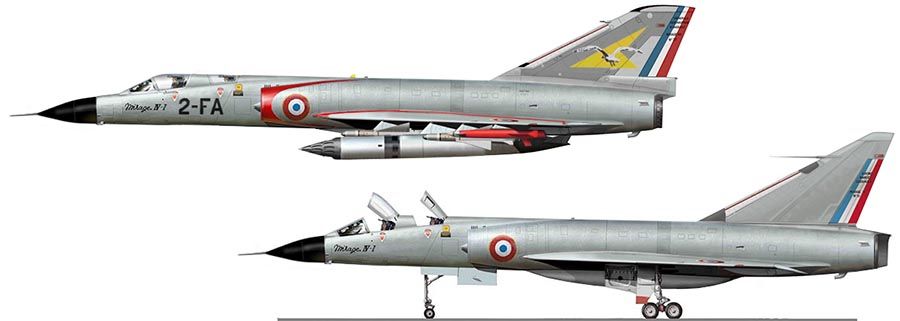
While '2-FA' carries the usual 4 x Matra R.530 missiles on pylons, this E.I.T. 2/2 Mirage's load-out is slightly odd. E.I.T. 2/2 was an early adopter of the Matra JL-2000 combined unguided rocket/fuel pod. The more anomalous aspect is the late retention of AA 20 missiles on the outboard pylons. [2]
Bottom: The Mirage IV-I 01 as originally test flown by Dassault test pilot René Bigand from Mérignac on 07 Nov 1963. Originally built as the Mirage IV 01 bomber prototype, this aircraft had suffered an inflight engine fire on 13 Feb 1963. [3] Restored as the Mirage IV interceptor prototype, the STAé agreed to some retrograde steps. These included restoration of the aircraft's original, lower-powered Atar 9Bs and taller vertical tailplane.
Although listed as Mirage IV-I n°1, the conversion was not truly representative of the production type. However, it gave Dassault a chance to demonstrate the type while proving its Thomson-CSF Cyrano radar installation. [4] Once fitted with pylons, the Mirage IV-I n°1 was finally delivered to the Armée de l'Air in February 1964 so that armaments trials could commence.
________________________________________
[1] E.I.T. = Escadron de interception et de transformation or Interception and Transformation (ie Conversion Training) Squadron
[2] AA 20 was an STAé designation for the Matra R 511 EM (ElectroMagnetic) in its R 052 configuration. The AA 20 was a comparatively poor performer and was replaced by AIM-9s once sufficient stocks were delivered to France. In turn, the Sidewinder began to be phased out in favour of Matra R.550s in 1975.
[3] While its fate was considered, the Mirage IV 01 airframe had 'donated' its tail to production Mirage IV n°12 and had its Atar 9Ds removed - one for reuse, the other to be salvaged for parts.
[4] True production Mirage IV-Is would not inherit the conversion's nez rond retroussé. Anticipating a possible AdA requirement that IRST be fitted, Dassault inserted an additional fuselage bay behind the radome (which also helped redress some balance issues).________________________________________
The AdA would not be the only operator of the type. At the same time as they were ordering the type, a nation with an even more pressing need was looking for a new interceptor. This was Canada and the Royal Canadian Air Force (RCAF) had suffered a tumultuous couple of years seeking a new type to replace their aging CF-100 Canuck interceptors. Initially their hope had been to develop and introduce the Avro Canada CF-105 Arrow however in February 1959, Prime Minister John Diefenbaker abruptly halted the development of the Arrow. Two months later the assembly line, tooling, plans, existing airframes, and engines were ordered to be destroyed.
After the cancellation the government officially maintained that the existing Avro CF-100 interceptors and the Bomarc missiles that had been ordered in September 1958 would be adequate for Canada's air defence needs. Unofficially, it was recognised that there was still a bomber threat and that the decision had been perhaps premature and that perhaps a interim manned interceptor should still be acquired. The plan was to acquire an existing type such as the Convair F-102 or McDonnell F-101 Voodoo with the USA indicating that surplus examples of both types might be available with the latter rapidly becoming the favoured option.
Debates in Canada raged over the proposal, both because the Voodoo was portrayed as a “hand me down” from the USA and more so because of the Voodoo's primary armament - nuclear-tipped AIR-2A Genie rockets. Unresolved, the Voodoo/Genie debate became a factor in the April 1963 collapse of the Diefenbaker government. The incoming Liberal government of Lester Pearson was quite happy to 'make hay' out of the Tory interceptor fumblings - both the cancellation of the CF-105 and muddled attempts to substitute American F-101s. But, to avoid another procurement débâcle, any future interceptor would still need to be a MOTS purchase. Fortuitously, the Mirage IVI was by now entering AdA service and Dassault made it clear that the type could readily be made available for Canadian needs as well.
Interestingly, Canadian connections with the Mirage IV began when Avions Marcel Dassault made inquiries in 1958 about Orenda's PS.13 Iroquois engine as planned for the CF-105. This turbojet was being considered as the powerplants for a proposed Mirage IV-B (Bombardement) - a strategic bomber twice the size of Dassault's built Mirage IVA. Of course, development of the PS.13 Iroquois ended when the Avro Canada CF-105 Arrow interceptor was cancelled but the connections with Dassault were still there and a basic familiarity with the big Mirage already existed.
Meanwhile further South, Australia was also in the process of acquiring the Mirage IVA. During 1961, the Australian government had sought a replacement for the Royal Australian Air Force (RAAF) fleet of English Electric Canberra bombers, largely in response to the Indonesian Air Force's purchase of missile-armed Tupolev Tu-16 bombers. Having only recently (December 1960) secured an order for the Mirage III to replace the RAAF’s CAC Sabres, Dassault proposed a version of the Mirage IVA. Australian Air Marshall Frederick Scherger recommended to the government that they considered purchase of the IVA because it was considered to be proven hardware already in service (in contrast to the competing BAC TSR-2 which was still in development). In early 1962, an order for 36 Mirage IVAOs and 8 of a dedicated reconnaissance variant the IVR (this basically using a dedicated camera pod in the belly location) was placed.
While negotiating the IVA deal, the RAAF officers were also introduced to the new IV-I in development. The RAAF was seriously considering a very long-range fighter to help the smaller Mirage III deal with the Indonesian threat. They also recognised the value in a type able to carry a heavier load of missiles than the smaller Mirage.
A 'long-legged' interceptor was also what the RCAF was looking for to satisfy the government’s new need and obviously Canada's NORAD requirement with the Americans getting frustrated by Canada’s indecision. The antipodal requirements would soon find alignment following discussions at the Paris Airshow in 1963. Over the coming months, Canberra and Ottawa hammered out an agreement to make a joint procurement of a largely common variant of the Mirage IV-I.
Under the agreement, the Dassault interceptor would be assembled in both Australia and Canada – as the Mirage IVI-O at Avalon and Melbourne, and the CF-115 at Cartierville. In order to achieve the increased range demand (since, ironically, the big Mirage only had a combat range 40km more than the smaller Mirage III in normal use), the joint Australian/Canadian variant introduced the use of a big semi-conformal belly fuel tank. Fitting into the recess on the type’s belly often used to carry a 1600L RS21 fuel tank, this also extended further externally and was able to carry 2000L. When used with external underwing 2500L tanks, a combat range some 55% greater (~2000km in total) was achievable.
The aircraft would enter RAAF service as the Dassault/GAF Mirage IV-IO (though in typical Australian fashion, it soon received the nickname “Big Belle”) and the RCAF as the Dassault/Canadair CF-115 Carnyx. [5] Main armament for both types was 4 x Matra R.530 missiles typically carried as per the AdA style in combined IR and SARH formats. These were typically jointed by a pair of Matra R.550s or AIM-9s on the outer wing pylons.
One interesting weapon used on some Mirages was the Matra JL-2000 combined fuel/rocket pod. Similar to the smaller JL-100 used on some Mirage IIIs, this took the basic concept and scaled it up to carry some sixty-four 68mm SNEB unguided rockets and 2000L of fuel. First trialled by the AdA, when fitted these potentially allowed a combination of four R.530s, two R.550s and up to 128 rockets along with the pair of internal 30mm cannon. Using such a combination would entail the following scenario: At ~25 – 30km the R.530s would be ripple fired in pairs (one IR guided and one SARH guided); the interceptor would then circle in behind the targets and from about 8 – 10km would fire its R.550s; it would then close to 1 – 1.5km to fire the rockets, usually in 3 – 4 volleys (it was also possible to use the rockets in a head on ‘in your face’ shot if attacking from the front), before finally closing and engaging with the cannon if still needed.
In operational service, the AdA used the Mirage IV-I in 3 regiments including the famed Régiment de Chasse 2/30 Normandie-Niemen. They were used primarily in the air defence role and tasked with intercepting any incoming bombers or strike aircraft. In the event of a major war and the AdA deploying their Mirage IVAs on nuclear strike missions, some of the IVIs were also able to be tasked as long range escorts with a pair typically escorting each IVA. Their role was to sweep ahead of the striker to destroy any potential Soviet interceptors attempting to engage the IVA. The IVIs would serve through to 1981 when replacement by the Mirage 4000 commenced.
In RAAF service, the Mirage IV-IO was used by No.s 13, 20 and 66 Squadrons operating from RAAF Bases Darwin, Butterworth and Williamtown. In a similar fashion to the AdA, they were used both in a pure interception role and also trained to escort RAAF Mirage IVA-O strike aircraft or IVR reconnaissance aircraft. The type was replaced by a combined Mirage 2000 and 4000 force in the mid – late 1980s.
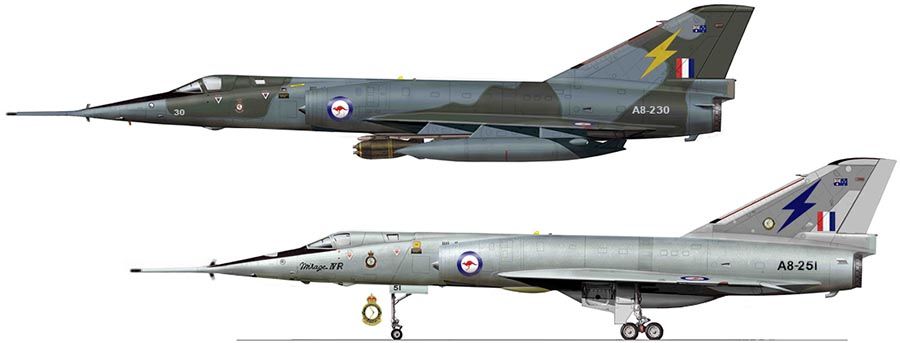
Loaded with 750 lb MK117 GP bombs, this Mirage IV-AO is enroute to the Evans Head bombing range for a practice drop. The belly bomb opening is covered with a fairing plate. [6] The outboard pylons - normally carrying jamming pods - here mount cine-cameras (to create stereoscopic films of bomb dispersal patterns).
Bottom: A Mirage IV-R photographic reconnaissance aircraft of No. 6 Squadron - also operating out of RAAF Base Amberley - in early 1967. At this time, the unit's main role was Mirage IV-AO conversion training but No. 6 Squadron's mixed fleet also took on the photo-reconnaissance role - with A8-251 being the first Mirage IV-R delivered to the RAAF. As photo-recce birds, the Mirage IV-Rs could carry a CT50 LA (Low-Altitude) or CT50 HA (High-Altitude) belly pod (equipped with cameras best-suited to either mission). This aircraft is shown in its 'clean' condition as delivered. Invariably, in RAAF service, Mirage IV-Rs would be flown fitted with pylon-mounted drop tanks for extra range.
______________________________________
[6] This bomb opening could be filled by an additional fuel tank. However, for the 400 km round trip from Amberley to Evans Head, this was considered unnecessary.
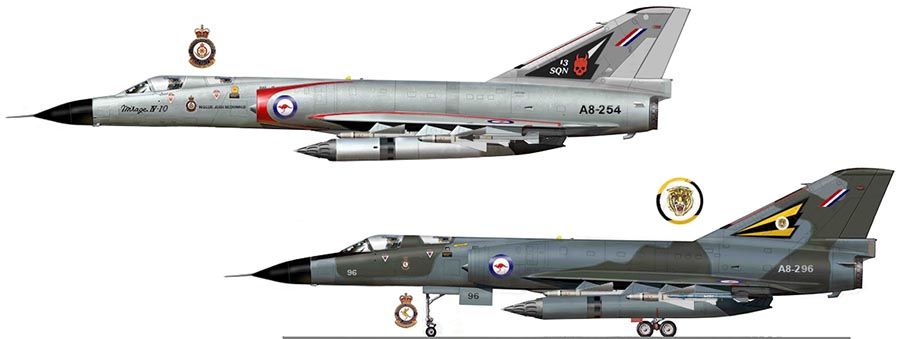
Bottom: Mirage IV-IO A8-296 on loan to No. 2 Operational Conversion Unit out of RAAF Base Williamtown, NSW. This aircraft wears the later camouflage scheme with 2 OCU's badge and fin flash providing a bit of colour. This Mirage IV-IO's load-out is identical to that above except for carrying inert AIM-9B practice missiles on the outboard pylons.
________________________________________
[7] This would later be revised into a more 'correct' red-black-red flash with the skull on a white circle.
[8] Named in honour of Wing Commander Joshua Roger Gray McDonald of No. 13 Squadron RAAF, killed along with three other crew members when Hudson A16-69 went down into the sea off Amboina, NEI, on 10 Dec 1941.________________________________________
The RCAF's CF-115A interceptors and CF-115D operational trainers served in the NORAD role with No.s 409, 410, 414, 416 and 425 Squadrons operating from Canadian Force Bases Comox, Uplands, North Bay, Chatham and Bagotville until 1982 when they were replaced by Canadair CF-215 Tornados - a Panavia Tornado IDS fitted with an American Hughes AN/APG-65 radar set. Canadian CF-115As were unique in that they almost always flew with the big belly tank and under wing tanks (either the JL-2000 or standard 2500L drop tanks).
A number of other air forces looked at the type, often as part of a combined purchase with the IVA strike aircraft. These included India, Israel, Saudi Arabia, South Africa, Taiwan, West Germany and India. For various reasons, none of these would proceed with a purchase though.
____________________________
[5] Chosen winner of names submitted by RCAF personnel, Carnyx - an Iron Age war trumpet - was chosen for its alliteration with assembler Canadair.
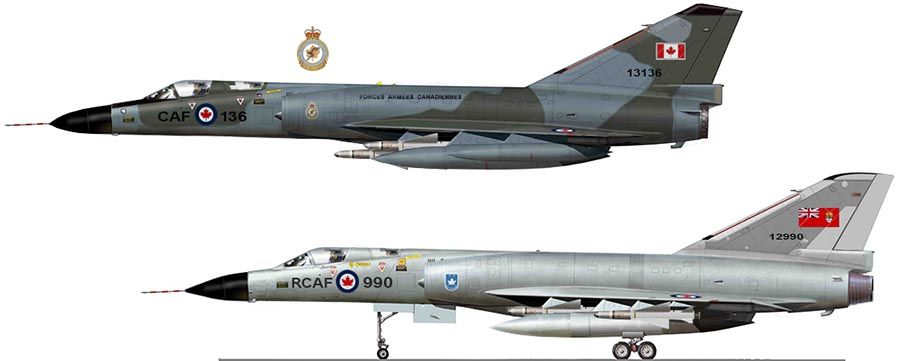
Bottom: A conceptual images of some of Canada's grander plans for the Mirage IV-I. Notable are a switch to Orenda Iroquois engines and fixed wing-tanks which also contained the main landing gear. [9] Less obvious is the change to Ferranti AI.23 AIRPASS radar. Alas, none of these developments would reach the production stage.
________________________________________
[9] The two missiles mounted on the rear, inboard pylons are not visible here. Partially seen are the belly-mount R.530 and portside inboard mount missile. Canadian CF-115s often dispensed with the outboard 'self-defence' pylons - partially to save weight and drag, partially because no fighter opposition was anticipated on the Carnyx's missions over Canada's Far North.