Ocean WanderersBy 1960, it was apparent that the Royal New Zealand Air Force’s (RNZAF) Short Sunderlands were obsolete and unable to detect modern submarines in training exercises. The following year, the New Zealand government proposed to begin scaling back the number of Sunderlands in service. In March 1964, a number of Lockheed P-3B Orions were purchased and these began entering service with No. 5 Squadron in September 1966. A detachment of two Sunderlands remained in Fiji for a time to carry out search and rescue missions as needed and continue maritime surveillance. The last of these was flown back to Hobsonville on 2 April 1967, marking the final operational flight for the type in New Zealand service.
Above: The outgoing Short Sunderland's and incoming P-3B Orions
In the following years though a number of incidents occurred whereby the combination of the reduced quantity of aircraft (16 Sunderlands down to 5 Orions) and the inability ability of the Orion’s to land on water to actually rescue people was sorely felt. The New Zealand government argued that the costs to purchase additional types would exceed Defence budget allocations; however, the Chief of Air Staff RNZAF, Air Vice-Marshal Air Vice-Marshal Cameron Turner, maintained that the additional aircraft were necessary if the Government still wished to maintain their capability. By 1969 this was threatening to become a major issue for the government of Prime Minister Keith Holyoake and to avoid becoming an election issue, in July that year it was announced that additional funding would be allocated to purchase new platforms and that efforts would be made to source a flying boat.
That said, there weren’t really many options available that would satisfy the RNZAF requirement. In fact, there was realistically only one: the in-development Shin Meiwa PS-1. This wasn’t an altogether bad option though. The PS-1 was a new four engined Maritime Patrol (MARPAT) and Anti Submarine Warfare (ASW) flying boat capable of an endurance in excess of 17hrs.
In 1970 the RNZAF made an approach to Shin Meiwa Industries and the Japanese government to purchase a number of the new type. This approach couldn’t have come at a better time as the PS-1 programme had become politically controversial as its relatively small production run resulted in an extremely high unit-cost for these aircraft. The RNZAF request for 10 aircraft would be a welcome addition and the Japanese government quickly approved the request. The first of these aircraft would be delivered in 1973 and would serve with the newly reformed No. 6 Squadron RNZAF. The unit was based at RNZAF Base Hobsonville with a detachment regularly operating from Laucala Bay in Fiji. In RNZAF service the type quickly became known as the PS-1 “Albatross” alluding to their long range and ability to float on the open ocean.
The acquisition of the PS-1 by the RNZAF did not go unnoticed. The usefulness of the long range, combined ASW/MARPAT capabilities and ability to land on the ocean surface to either deploy a dipping sonar or to rescue people was quickly recognised, especially both those air forces who had previously operated flying boats. The fact that Shin Meiwa Industries and the Japanese government were actively marketing the type, having formally adopted the RNZAF Albatross name helped as well.
First new user was the Dutch "Marineluchtvaartdienst" (MLD - Naval Aviation Service) who issued a tender for a SP-2H Neptune replacement in 1974. Contenders for this included the American P-3 Orion, British Nimrod and the French Breguet Altantique NG. At the end of the selection process an order was placed for 8 PS-1 Albatross and 8 P-3C Orion aircraft to equip No.s 320 and 321 squadrons respectively. The main mission for the Dutch aircraft was ASW, contributing to NATO’s protection of the sea lanes between Europe and North America. The MLD also flew patrol missions over the North Sea and northern part of the Atlantic Ocean, as well as SAR (search and rescue) and coastguard missions. MLD Albatrosses also conducted anti-narcotics operations over the Caribbean out of Curacao.
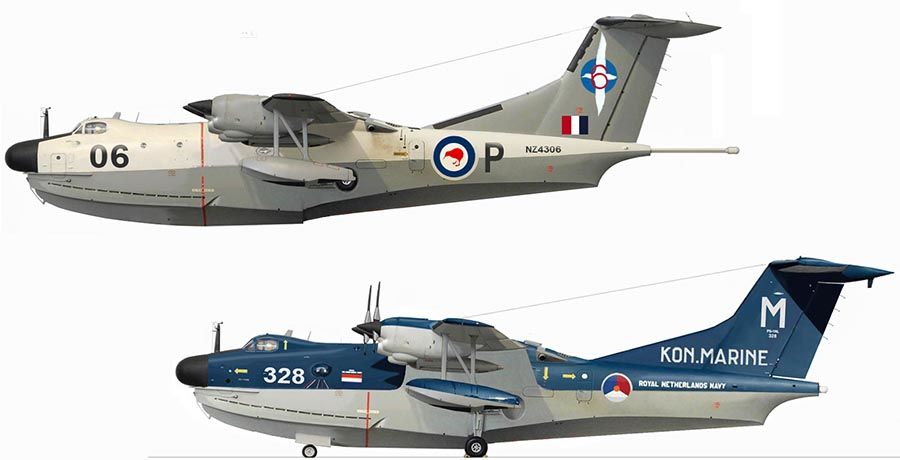
Distinct to the Albatross fleet (and a nod to earlier RNZAF Sunderland flying boat markings) were individual aircraft letters - NZ4306 being 'P'. On the nose was displayed the No. 6 Squadron crest featuring the Māori god Tane who adopted an attitude of watchfulness during long sea voyages. However, the tail emblem is an albatross volante taken directly from land-bound No. 5 Squadron RNZAF.
Although home-base was RNZAF Hobsonville, a seasonal detachment from 'Hobby' was routinely deployed to RNZAF Lauthala in Fiji. A combination of salt spray and the South Pacific sun was harsh on finishes. Within 5 years, under Operation Tane, the RNZAF Albatross fleet underwent a refurbishment programme. The original 2-tone scheme was replaced by all-over medium grey with reduced-scale roundels.
Bottom: A Dutch PS-1NL Albatros of the Marineluchtvaartdienst's 320 Squadron on its beaching gear at the new seaplane base established at Middenhof (on the Oosterschelde, just west of Bergen op Zoom in North Brabant). The standard MLD flying boat scheme of Donker oceaanblauw over Licht zeegrijs is worn. Distinct to PS-1NLs is the 'M' (for Middenhof) tail marking.
A rotation of 320 Squadron usually made up the 'Afdeling MLD' (Detachment MLD) moored at Sint Annabaai (Willemstad) on Curaçao. However, 320 Squadron Albatros also joined 321 Squadron P-3Cs deployed to Iceland on occasion (the Orion det going to Keflavik AB while the PS-1NLs moored at the Njarðvík quays in Keflavíkurhöfn just east of the air base).Next was Australia who in 1975 was looking for a replacement for the Lockheed P2V-7S Neptunes of No. 10 Squadron. After working with their RNZAF counterparts and seeing the capabilities of the Albatross, they placed an order for 14 aircraft without worrying about a competition. The first of these would arrive in 1977 and be operated from RAAF Base Whitsundays. Like the Dutch, the RAAF Albatrosses would work in conjunction with the P-3 Orion’s of No. 11 Squadron in the ASW/MARPAT/SAR roles and conduct deployments all around Australia and into SE Asia. They would develop a particular reputation for rescuing sailors from yachts including both the annual Sydney-to-Hobart race and the Whitbread Round the World Race with the type’s unique ability to land on the open ocean of particular benefit.
The next operator would be Brazil which order 6 of the type for the to operate alongside the Força Aérea Brasileira (FAB - Brazilian Air Force) to complement their Embraer P-95B Bandeirulha MARPAT aircraft.
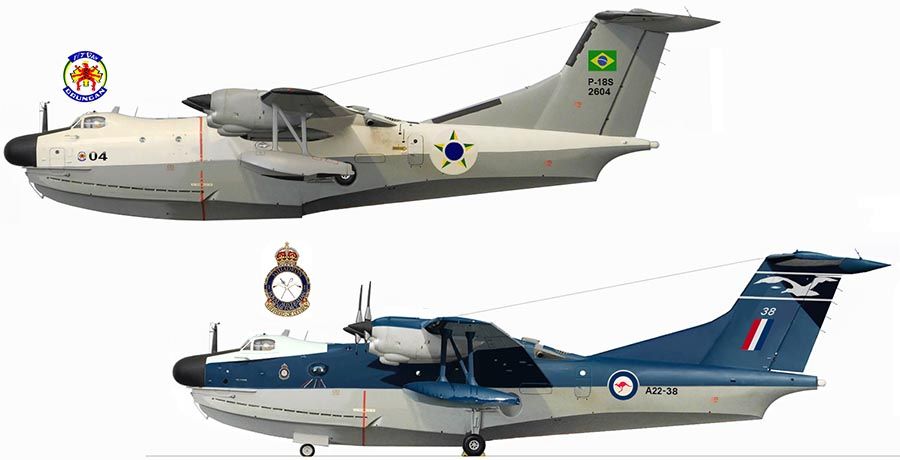
In Brazilian service, the PS-1BR was designated as the P-18S. The 'P' was, of course, for Patrulha (Patrol). FAB designation numbers were not usually sequential but the P-18S followed the pattern of the earlier P-15 Neptune and P-16 Tracker. The 'S' suffix was for busca e Salvamento (Search and Rescue).
On its nose, P-18S 2604 wear the 1°/7°GAV Esquadrão Orungan crest and the 'last two' of its FAB serial number. During their mid-life refurbishment, the P-18S fleet were repainted in a Verde escuro over Cinza médio scheme based on that of land-based P-95B Bandeirulha maritime patrol aircraft. Eventually, that green-grey scheme also received low-visibility national markings.
Bottom: An Australian SMI PS-1AU of No. 10 Squadron RAAF based at RAAF Base Whitsundays off the coast of Queensland. This Albatross wears the standard RAAF flying boat scheme of Dark Sea Blue over Sky. To this has been added a reflective white coating around the cockpit (found necessary for 'boats left at moorings in the intense Summer sun).
This PS-1AU carries the No. 10 Squadron crest on her forward hull and a stylised Albatross on her tail. As with all Albatross, the serial A22-38 'last two' reference this aircraft's Shin Meiwa construction number - only 14 PS-1AU actually served with the RAAF. Notice that, while on dedicated SAR patrol duty as here, PS-1AUs often had their underwing torpedo pods removed to save weight.
_____________________________________
[1] Apart from inter-service budget squabbling, FAB has successfully argued that all fixed-wing aircraft should be under its control. A secondary argument was that GE T64-IHI-10J spares from PS-1BR/P-18S engine stocks - bought in sufficient quantities - would help keep FAB C-115 Búfalo tactical transports of 1°/9°GAv flying.The final operator would be back in Asia with the Tentara Nasional Indonesia Angkatan Udara (TNI-AU – Indonesian Air Force) ordering a combination of 3 PS-1s and 3 of the associated US-1A variant. The latter in particular found heavy use in providing logistics support amongst the various islands making up the Indonesian archipelago.
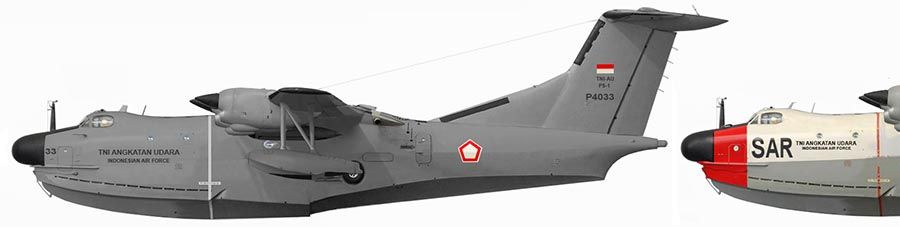
Albatros P4033 wears the overall abu-abu sedheng (medium grey) applied to refurbished PS-1s. As delivered, the ASW flying boats had high-visibility roundels in four positions and the gendéra nasional on either side of the tail fin. These would later be painted over and low-viz roundels and flags applied in their place.
Inset: The nose of an Indonesian US-1A(ID) Albatros of the TNI-AU's Skadron Udara 31 (Detasemen US/SAR). These amphibious flying boats were based at Kakas (on Lake Tondano) on the Minahassa Peninsula of northern Sulawesi. Later, along with PS-1(ID) maritime patrol aircraft, additional detachments were deployed to the revived Morokrembangan flying boat base at Surabaya in eastern Java.
As delivered, the Indonesian US-1A(ID) 'boats wore the same 2-tone scheme as JMSDF US-1As with added high-visibility 'dayglo' panels fore and aft.



