Antipodal Armoured CollaborationDuring the 1991 Gulf War Australia initially looked at deploying a combined arms armoured brigade as part of their contribution to the United Nations (UN) coalition. This was not proceeded with though, due to a confidential assessment that the Australian Army’s Leopard AS.1 main battle tanks and supporting M113 armoured personnel carriers would not be up to the requirements of a modern battlefield and, to use the blunt language in the assessment, be “dead meat”.
Following this, the Australian Army pushed for an upgrade to their entire Heavy Armoured capability. Ideally, they hoped to replace the current Leopard AS.1s and M113s with something such as new M1 Abrams MBTs and M2 Bradley infantry fighting vehicles (IFVs). Unfortunately, the Australian economy in 1991 was still struggling, being technically in recession. While acknowledging the need to upgrade the armoured capability, Minister for Defence, Senator Robert Ray, advised the Chief of Army, Lieutenant General John Coates, that at best an upgrade to the fleet would be possible.
In parallel to this, the Canadians were also looking at the lessons of the Gulf war and the implications it would have for their capabilities. Like the Australians, the Canadians ideally would like to replace their Leopard C.1s with something such as the M1 Abrams and M2 Bradley. However, also like the Australians, the Canadian economy was in recession at the time thus ruling out new types.
Common challenges often lead to common solutions and in this case the respective armoured project teams happened to meet with each other at the 1992 Association of the United States Army (AUSA) conference and began talking about their common woes. These talks soon turned to possible solutions. The result would be the Leopard ASC.2 upgrade.
This was a major upgrade to the Leopard 1 to make it more survivable, lethal and supportable. Amongst the changes, the upgrade replaced the 105 mm Royal Ordnance L7 rifled gun with an Israeli 120mm IMI MG251 gun (similar to that used in the Merkava Mark IIIand roughly equivalent to the Rheinmetall L/44 gun of the Leopard 2). This was thus conceptually similar to that prototyped as part of the German Leopard 1A6 upgrade a few years earlier and thus represented a low-risk solution to the lethality component. The survivability component would be primarily solved through the adoption of an extremely thick MEXAS appliqué armour kit. The additional weight of the armour and main gun also necessitated an upgrade to the propulsion side with the larger, more powerful 1400 hp MTU MB 838 Ka-501 engine being introduced along with a reinforced ZF 4 HP 250 automatic transmission. Other subsystems such as a new Elbit fire control system, improved radios and the Automated Fire Extinguishing System (AFES) were also part of the upgrade. The end result was a more agile, better armed and better protected system at less than half the price of a new tank design. Both armies and their respective governments were pleased.
Australia would convert its entire 90 Leopard MBT fleet to the new ASC.2 configuration. The 5 Armoured bridge-layers and 8 Armoured Recovery Vehicles were also given elements of the same upgrade (engine, transmission, AFES, radios). Although initially looking to upgrade all their Leopard C.1s, in the end Canada decided to only upgrade 86 to the new ASC.2 configuration with the remaining either sold, put in museums, used as monuments, or turned into range targets. They did however upgrade their Armoured bridge-layers, Armoured recovery vehicles, and Armoured engineer vehicle in a similar manner as the Australians.
In parallel with the Leopard ASC.2 program both countries also decided to work together on addressing their equally vexing problem of lack of modern Infantry Fighting Vehicles (IFVs). And just as with the MBT requirement, while both armies would like something such as the Bradley (or even older Marder), economies and budgets dictated otherwise. Once again, a common solution would be pursued. This combined the Canadian Armoured Personnel Carrier Life Extension (APCLE) and Australian Project Land 106, booth of which were focussed upon upgrading the respective armies’ M113 fleets. The resulting vehicle (or more so, family of vehicles) would be known as the M113ASC.4 and like the Leopard ASC.2, represented a significant upgrade to the type.
The basic M113ASC.4 essentially turned the Vietnam era M113A1/A2 to a modern IFV. The upgrade involved stripping the existing vehicles back to bare hulls, lengthening to 6m, and then installing new engines (350 bhp MTU 11.9 litre diesels) and steering controls, drive train, electrical and fuel systems as well as a newly designed internal layout. MEXAS ceramic composite appliqué armour was also fitted giving the upgraded vehicles enhanced protection. Additionally, Israeli developed reactive armour was also able to be fitted if need be, though it was rarely used due to the additional weight and effort in fitting. Mine blast protection along with modern AFES was also added, as was laser-warning receiver, and smoke grenade launchers, rounding out the protection aspect. Perhaps the most visual change though was the addition of a new turret. This was the same basic turret as used on the then in design Canadian Coyote reconnaissance vehicle, which itself was based on the design of the LAV-25. This electrically driven turret came equipped with a 25mm M242 Bushmaster chain gun and two 7.62 mm machine guns in addition to optional TOW missile launcher capable of carrying two loaded missiles. The upgraded vehicles had a crew of 3 and ability to still carry 8 troops although this was quite cramped and it was more common to carry only 6 troops in the back.
Australia would convert a total of 252 M113s to the new ASC.4 configuration along with a number of other specialised variants that would adopt various elements of the upgrade package. Canada would convert a total of 341 (later reduced to 254) to the new standard and would also incorporate many of the upgrades in other specialised variants. In Canadian service they would be known as the Mobile Tactical Vehicle, Combat (MTVC). In addition to the basic IFV variant, both countries would convert multiple other M113 variants to the new basic standard with changes other than the turret.
The Leopard ASC.2 and M113ASC.4 continued in service with the Australian and Canadian armies for the next 20 odd years through to 2015. At this point the Australians and Canadians decided to continue their successful collaboration undertaking a joint purchase of 120 (60 each) new Leopard 2A7+ AUSCAN variants along with ARV, AEV, ABL and ABV variants plus 450 (300 Australian and 150 Canadian) Puma AUSCAN IFVs from Germany. These continue in operation today reinforcing decades of antipodal armoured collaboration.
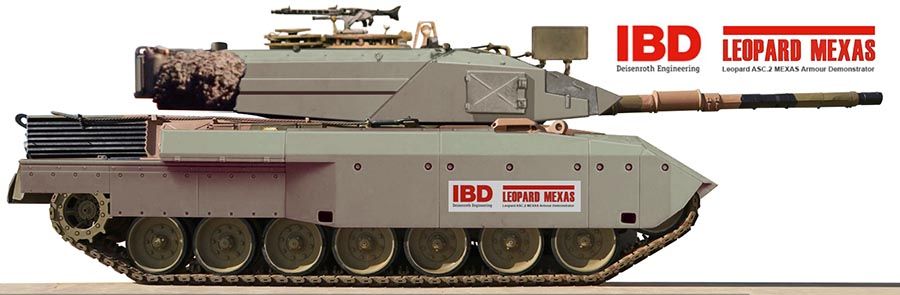 Above: The IBS Deisenroth 'Leopard MEXAS Armour Demonstrator' was a test-fit of that firm's composite armour package to a Leopard AS.1 on loan from the School of Armour at Puckapunyal, Victoria. While the MEXAS kit was representative of the final armour fitment, this vehicle retained its original gun, fire control system, and powerplant.
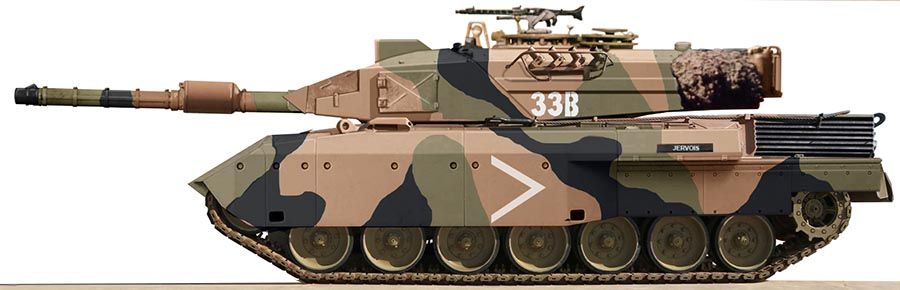 Above: Shown here, 'JERVOIS' was the first fully upgraded Leopard AS.2 'production' conversion. Delivered to the 1st Armoured Regiment at Puckapunyal, the pristine finish would not last long. Within weeks of taking on its Leo AS.2s, 1AR would be transferred north to Darwin.
Beyond the MEXAS add-on armour, noteable changes for the Leopard AS.2 are the stouter Israeli 120mm IMI gun and rooftop sights for the Elbit Baz FCS. Less obvious is the rear turret basket extension to accommodate a larger AC unit.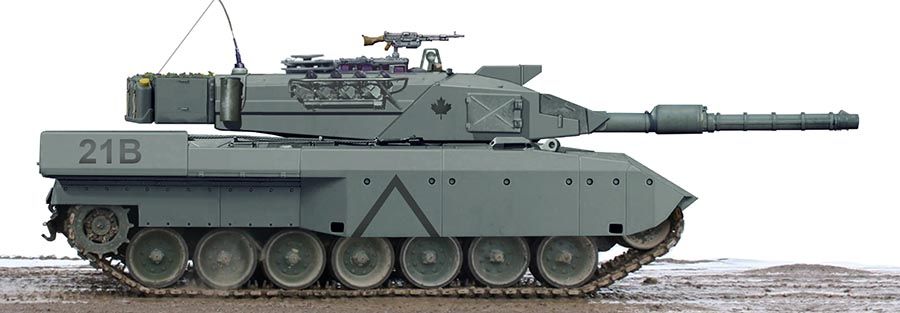 Above: A near-new Leopard C2 MEXAS - 21B of Lord Strathcona's Horse (Royal Canadians) - on training manoeuvres at CFB Wainwright in eastern Alberta. That 21B marking makes this the second tank of LdSH(RC)'s B Squadron, 1 Troop.
Differences between the Canadian C2 and Australian Leopard AS.2 were mainly about stowage details and secondary armament (the Canadian Army preferring C6 GPMGs while the Australian Army used German MG3s). However, the Leo C2 MEXAS dispensed with AC while adopting exhaust baffles (to reduce the tank's thermal signature in Winter temperatures).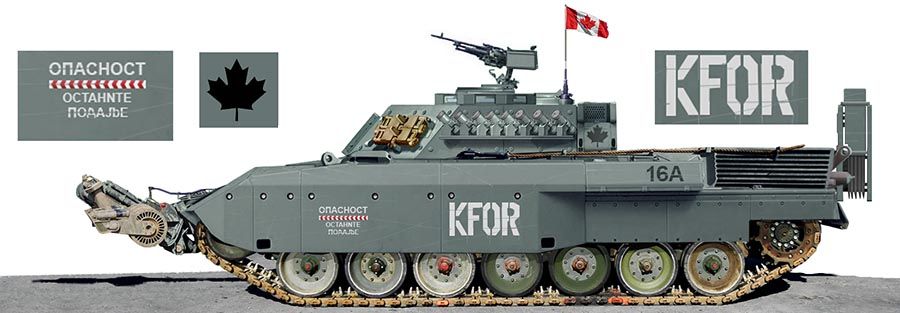 Above: This Badger C2 MEXAS dozer tank belonged to 1er escadron, 12e Régiment blindé du Canada - that 12eRBC unit having converted from LAVs to Leopard C2 MEXAS in early 1999. 12eRBC deployed from Valcartier to Kosovo later in the year. For the NATO-led Kosovo Force mission, white 'KFOR' lettering was stencilled onto the sides, front, and back of vehicles.
Although officially la Force pour le Kosovo in French, the KFOR acronym was retained. Further straining linguistics, the '12th Rubber Boot Company' have also applied Serbian language warning signs to the skirt armour (reinforced with a stripe of warning tape). This Badger is also flying a small Canadian flag from its antenna to emphasise its non-combatant status in Kosovo.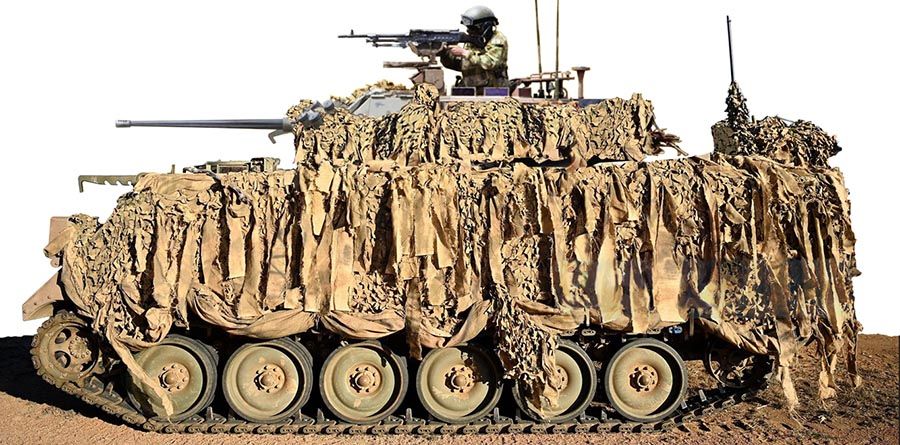 Above: 'Chopper ', an M113AS4 infantry fighting vehicle of the 5th/7th Battalion, The Royal Australian Regiment (Mechanised Infantry). Although based at Cultana Barracks in South Australia, this heavily camouflaged 5/7 RAR vehicle is shown while deployed on manoeuvres outside Darwin in Northern Territory. [1]
Note the commander's FN MAG machine gun mounted on a double-articulating swing arm. A folding wire-cutter in front of the driver's hatch ensures clearance for the 25mm M242 main gun.
[1] In early 2007, 5th/7th Battalions were de-linked and 'Chopper ' was assigned to the revived 7th Battalion (before being deployed to Afghanistan as part of ISAF's Operation Slipper in Sept 2008).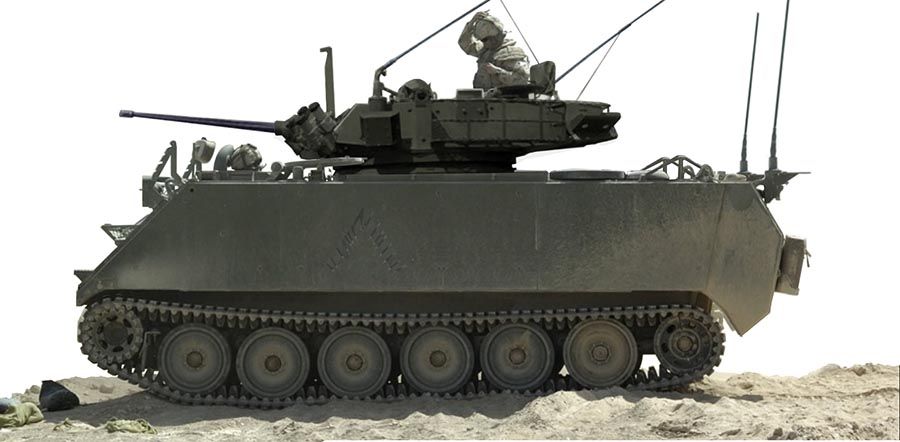 Above: Callsign 'Grizzly Six' - An ISTAR Mobile Tactical Vehicle, Combat (MTVC) during the second battle of Panjwaii (Op Medusa). [2] Part of the Royal Canadian Dragoons' recce squadron under Major Andy Lussier, this MTVC gave covering fire and provided targeting information for accompanying RCD and PPCLI infantry units.
This MTVC would later be nicknamed 'Peace Pipe', a reference to its crew's habit of festooning their IFV with cut stalks of Cannabis sativa to better camouflage their stationary vehicle among the marijuana fields in this province west of Kandahar City.
[2] As recce vehicles, the ISTAR MTVCs were shod with quieter-running Soucy CRT 'band tracks'. The CRTs stood up well in Afghan 'moon dust' but less so where broken rock dominated. However, for the recce role, regular track changes were considered a price worth paying for gained stealth.



