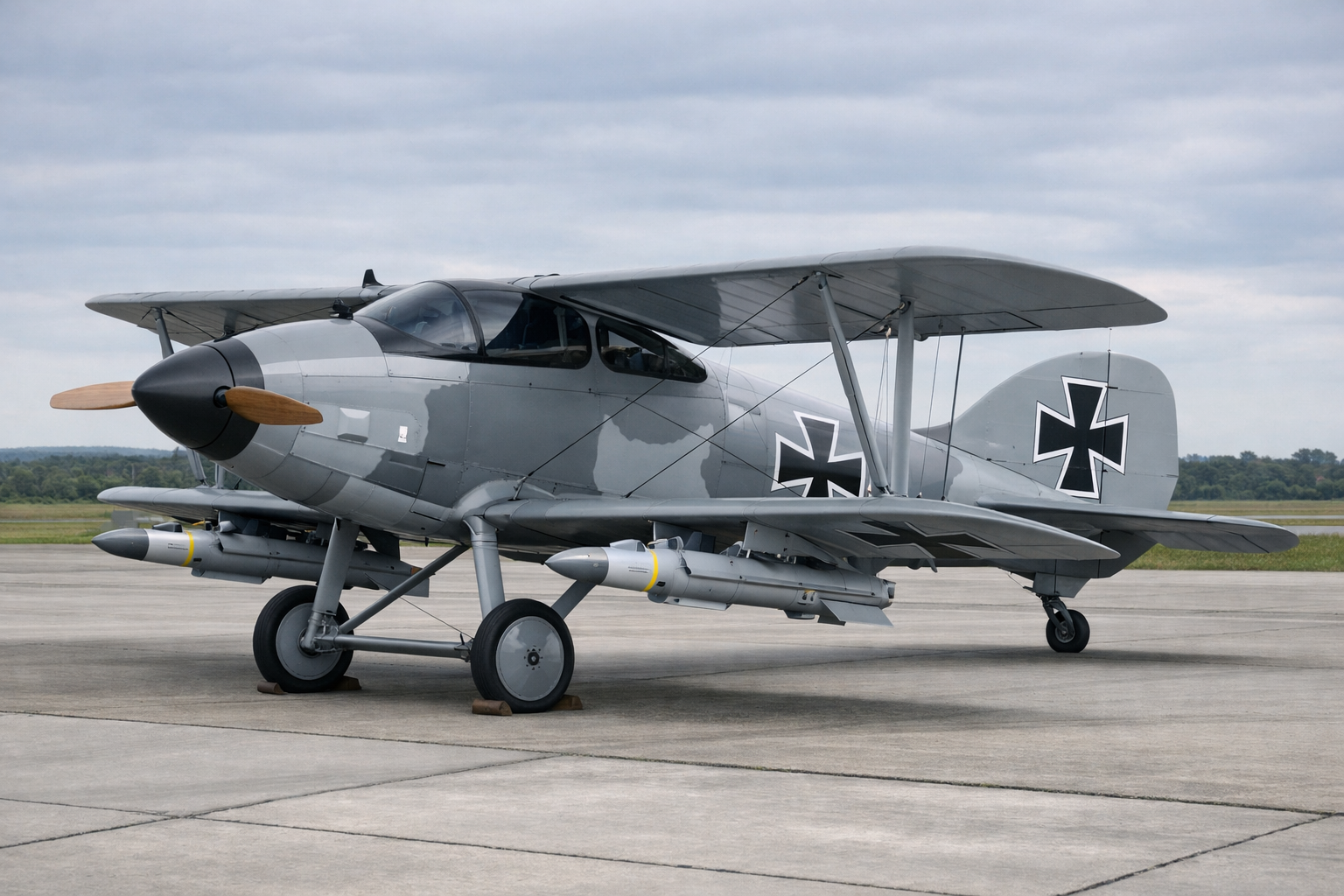
Agile AegisBetween 1951 and 1954 Australia and the United Kingdom jointly developed the Malkara (“Shield”) Anti-tank guided weapon. This large missile was one of the first of its type to be introduced to service (in 1958). It had a range of 4000m, carried a large 26 kg HESH warhead and used Manual command to line of sight (MCLOS) guidance with signals sent via trailing wires to the missile.
Because of its size (93.5 kg), it was far too large to be man portable and instead was carried either by the FV1620 Humber Hornet specialised air-deployable armoured fighting vehicle (carrying twin missiles on an elevated launcher) or by the humble Land Rover (carrying a single missile). Although a challenging missile to use and requiring a well-trained operator, when the missile did work it was deadly against even the latest Soviet tanks.
Concurrent with the introduction of the Malkara, the British and Australian Defence Forces were starting to get used to another relatively new addition to their capabilities. This being the helicopter. After earlier types that were limited in capability, by the mid 1950s, improved versions were now in or entering service. It was only natural that both the helicopter and the ATGM would be paired to form a fast reacting, heavy hitting weapon system, much as the cavalry once was in earlier times.
One of the first such combinations was the British Bristol Type 171 Sycamore with the Malkara. Two such missiles were able to be carried by the Sycamore, thus providing a capability equivalent to the Humber Hornet but with far greater speed and agility. The first such platforms entered the British Army Air Corps (AAC) in 1959. Eventually 24 of the type would be operated. A small number ( 8 ) were also acquired by the Royal Australian Air Force at the same time. Also operating the type was the newly re-formed German Army which ordered 12. These would operate alongside their British Army of the Rhine (BAOR) counterparts.
By the end of the 1960s, all would be replaced by more advanced types (both missiles and helicopters) such as the Bell UH-1 Iroquois, Westland Scout or Sud Aviation Alouette III and fitted with missiles such as the Nord SS.11/SS.12 or Swingfire.
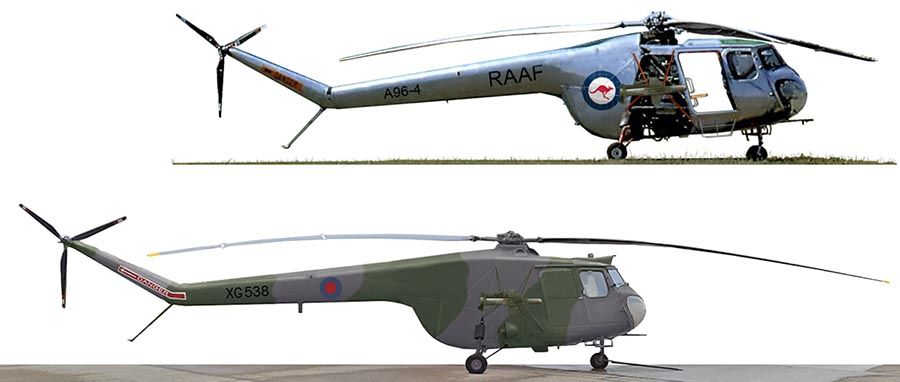 Top: RAAF Bristol 171 aka Sycamore HA.50M anti-tank helicopter. [1] Sycamore A96-4 was one of two RAAF development prototypes. Here, A96-4 is shown with multiple panels removed for weight-savings (and extra cooling) during hot weather flying. [2]
The development Sycamore HA.50Ms differed from operational service aircraft primarily in the sights fitted. Here, A96-4 is equipped with the original, fully-internal CSIRO devised target-aiming and missile-guidance sight. Fixed in place, this direct line sight was replaced by the periscopic Lucas unit which added some drag but had the benefit of an eye-piece which could swing out of the way when the sight was not in use.
Bottom: British Army Sycamore Mk.5 (HAM.5) anti-tank helicopter attached to the British Army of the Rhine. This aircraft (XG538) belonged to No.1904 Flight of 653 Squadron AAC at RAF Detmold in West Germany in late 1958. Note the rooftop Lucas Industries periscopic sight and attached rear window blanking panels.
_____________________________________________
[1] Standing for 'Helicopter, Attack, Mark 50, Malkara'. A Sycamore HA.50M seconded to the RAN for trials was redesignated HMA.50M - for 'Helicopter, Maritime Attack, Mark 50, Missile'.
[2] Removing the rear doors also eliminated the risk of blast damage to rear windows when firing the Malkara missiles.