Fjord FlygebladerIn the late 1930s many in Europe could see that the continent was heading towards war. Nazi Germany was rearming in a major way and making all sorts of threats to its neighbours. Similarly, those countries elsewhere in Europe were also rearming in response. The remilitarisation of the Rhineland in 1936 was first step and then in March 1938 when Germany annexed Austria things reached even higher levels.
To the North of the main European countries, Norway was also watching with concern. Although Norway had a long history of adopting a position of Neutrality like its neighbour Sweden, it was also very aware of the need to protect itself. As such the Minister of Defence, Fredrik Monsen, an avowed antimilitarist, reluctantly directed the Forsvaret to deliver a plan for better equipping the country for possible future conflict on its doorstep. At this stage it was hoped that the country could still avoid conflict by remaining neutral and that and action would be restricted to possible deterring incursions on its territory, airspace and waters.
As airpower had increased in significance over the last 20 years, the Hærens flyvåpen (Norwegian Army Air Service - NoAAS) and Marinens flygevåpen (Royal Norwegian Navy Air Service – RNNAS) were to play a significant part in this effort. At that stage, the most advanced combat aircraft in service were the 12 new Gloster Gladiators the NoAAS had just started to acquire. These were already felt to be outclassed though and thus something more modern was sought.
Options looked at included the British Hawker Hurricane and Supermarine Spitfire; German Bf-109; French Morane-Saulnier M.S.406 and Bloch MB.150; Italian Fiat G.50, Macchi C.200 and Reggiane Re.2000; and American Curtiss P-36/Hawk 75, Curtiss-Wright CW-21 and Seversky P-35. The challenge with almost all types was that their own countries were also wanting them thus placing delays on the likely in-service dates. Eventually in August 1938 an order was placed with Seversky for 60 of their design in multiple variants including:
• 24 of the basic single seat AP-7 for the NoAAS
• 12 of the twin seat 2PA-L (Land) for the NoAAS
• 12 of the AP-7A (Amphibian) for the RNNAS
• 12 of the twin seat 2PA-A (Amphibian) for the RNNAS
All types were powered by a 1,200hp Pratt & Whitney R-1830 Twin Wasp engine with armament for the single seat versions being two 8 mm machine guns in the cowl and two 13.2 mm machine guns in the wings with the guns selected to align with Swedish orders. The twin seaters added to this with a single 8 mm gun on a flexible mount in the rear cockpit. All versions were also able to carry up to 227 kg of bombs.
The first of the new Seversky fighters (four AP-7s and two 2PA-Ls) arrived in September 1939 and over the next 6 months more arrived including the float equipped versions for the RNNAS. The latter were allocated a single unit with four operational detachments (or air groups) each comprising three AP-7As and three 2PA-As, operating out of a number of Norway’s fjords including:
• Lysefjord Air Group
• Romsdalsfjord Air Group
• Hardangerfjord Air Group
• Sognefjord Air Group
The new units were established just in time for the German invasion in early April, but were still largely undergoing initial training. That training was rapidly curtailed with all available units now thrown into the defence against the Germans.
Over the coming weeks the NoAAS and RNNAS units provided a valiant defence of their country fighting alongside British Royal Air Force (RAF) and Royal Navy Fleet Air Arm (RN FAA) squadrons deployed to the war zone. After some initial losses, especially when some NoAAS units were caught on the ground in the initial attack, the Norwegian crews gave a good account for themselves shorting down attacking Luftwaffe bombers, reconnaissance aircraft, transports and fighters. The floatplane versions flown by the Fjord Flygeblader were something the Germans had especially not taken account of. Although somewhat lacking in performance due to the dragging floats, the fact that these could operate from almost any waterway (not just the fjords but also lakes) and because their ‘runways’ were unable to be put out of commission, was a significant advantage.
That said, numbers and performance count as did the ground war situation and against the Luftwaffe Bf 109s and Bf 110s the Severskys were outclassed. The remaining forces were gradually whittled down as they pulled back. Finally in early May, the surviving aircraft were forced to evacuate with some flying to Sweden and some floatplanes making a perilous long overwater flight to Scotland. Here they would be absorbed into the RAF and form the core of a number of RAF squadrons.
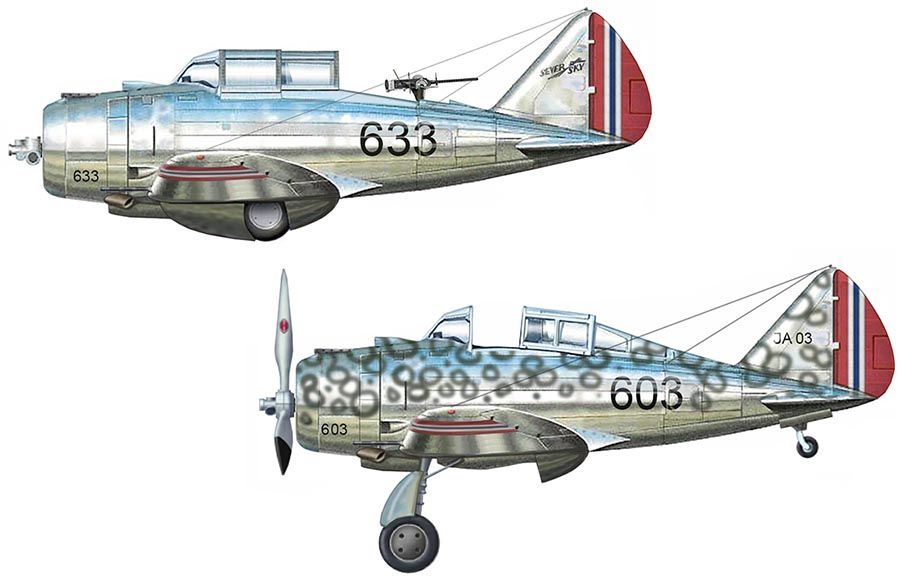
Despite the reconnaissance designation, most JRs - including '633' were attached to the HF's Jagevingen at Fornebu, Oslo. When the Germans attacked on Norway on 09 April 1940, the entire Jagevingen scrambled to intercept Luftwaffe bombers. JR '633' shared a claim on a damaged He 111 of KG 30. However, upon return to Fornebu airfield, the aircraft was shot-up on the ground while rearming and refuelling.
Bottom: A Seversky AP-7 fighter of the Hærens Flyvevesen in early June 1940. Designated JA (for Jagerfly-Avskjæringsfly or fighter-interceptor) by the HF, the single-seat Severskys shared Jagevingen fighter duties with JFs (Gloster Gladiator II biplanes). [1] When the Germans attacked Norway on 09 April 1940, JA '603' was still deployed in Finnmark to deter further Soviet aggression in the north.
Assigned to support 6. divisjon. The Finnmark Severskys - JAs and JRs - took part in the liberation of German-occupied Narvik on 28 May 1940. By this time, a rough 'figur 8' scheme of disruptive camouflage had been applied over the natural metal finish (although, apparently, the ground crew had failed to reach a consensus as to how the finished scheme should appear).____________________________________
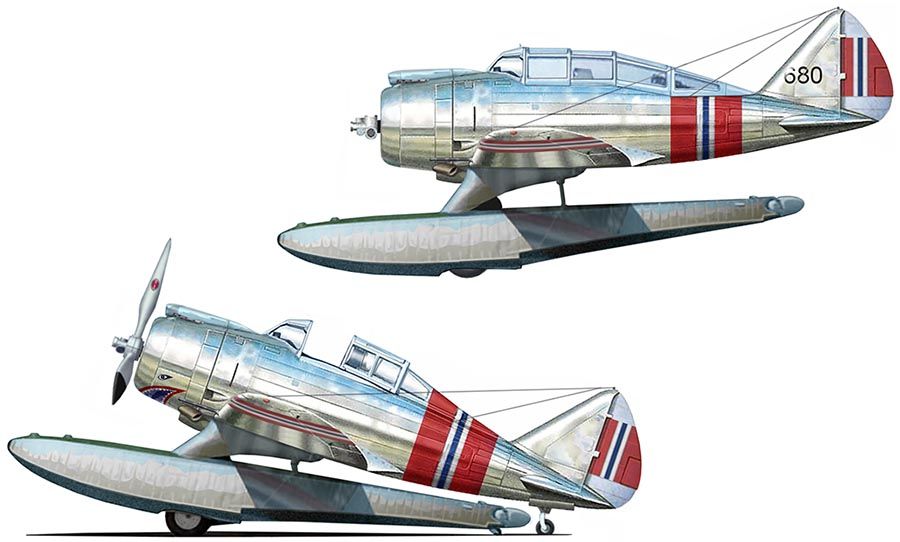
This aircraft had been based at Skattøra (Tromsø) in April 1940 and took part in the 28 May freeing of Narvik. When the Allies left Narvik, '680' was first pulled back to Tromsø and then to Hammerfest. Once the Norwegian surrender was announced on 10 June, '680' left Hammerfest for Lake Salmijärvi at Petsamo and exile in Finland.
Bottom: One of a dozen Seversky AP-7A (Amfibie/Amphibian) marinejagerfly of the Marinens flygevåpen. Delivered in the same scheme as the 2PA-Ls, this aircraft's individual number - '694' - was overpainted by a new fuselage band. [3] However, the replacement tail fin number had yet to be applied when the Germans invaded on 09 April 1940.
When the German invasion began, '694' scrambled from the naval quay at Kristiansand to engage Luftwaffe aircraft. After radioing a claimed 'kill', the pilot of '694' was ordered to retreat north to Trondheim. Unaware that German troops had already landied at Ravnkloa in Trondheim's main harbour, the Seversky was flown into an ambush. The pilot was forced to surrender but German small arms fire had already lit his mount alight.
____________________________________
[1] All Gloster Gladiator Mk.I biplanes were in the process of conversion to recce-fighters equipped with fuselage-mounted German Fritz Völk Hk 12.5/7x9 cameras modified for Bowden cable operation.
[2] Seversky Aircraft delivered the Marinens flygevåpen aircraft with correct tail and wing markings. However, the fuselage bands were omitted and individual aircraft numbers were applied to the fuselage sides. The missing fuselage bands were applied at Horten while the Severskys were being reassembled for service.
[3] However, the replacement tail fin number had yet to be applied at the time of the Germans invasion. Note that all assigned Marinens flygevåpen aircraft numbers were 'even' (while Hærens Flyvevesen numbers were 'odd').



